


Hello there!
This week, we’re starting to question what happens when an LP decides it doesn’t just want exposure to the fund, but wants a piece of the manager?
That’s the interesting part of Temasek’s acquisition of a 9% stake in Milan-based private equity firm FSI’s management company, coupled with a commitment to future funds. Temasek has been investing in FSI’s funds for a while, making this less a new relationship and more a significant evolution of an existing one.
Could this be an early sign that global institutions are moving beyond one-off fund commitments toward deeper, more permanent relationships with the European managers they already back?
From investing in the fund to investing in the franchise
FSI manages around €5bn, with its two flagship funds raising €1.4bn and €1.6bn. Temasek’s 9% holding doesn’t give it control of the firm, but that isn’t really the point.
As an LP, Temasek participates in the performance of individual FSI funds. As a shareholder in the management company, its exposure extends to the franchise behind those funds, including the economics generated as FSI raises and manages capital over time.
Because Temasek is also committing to future funds, the transaction ties together two things that have traditionally been separate: capital allocated to the product and capital invested in the producer.
For FSI, that creates a long-term institutional shareholder with considerable capital and international reach. For Temasek, it creates a bigger relationship with a manager it has already spent years underwriting.
That long-standing relationship may be the most important detail in the transaction.
Private-market fundraising has become increasingly relationship-driven. Around 70% of recent commitments have gone to existing GP relationships, according to Moonfare.
In that environment, buying a stake in a manager you already know is less of a leap than it might initially appear. It follows the same logic: if access, trust, and repeat relationships matter more, the largest LPs have an incentive to make those relationships harder to displace.
Global institutional capital taking a fresh look at European PE
While zooming out from Temasek, we started looking at who is backing some of Europe’s latest funds.
US public pension plans such as Connecticut's are committing to Nordic and UK mid-market vehicles, and sovereign wealth funds from the Middle East and Asia are cited among the LPs in recent European closes. Several managers, including H.I.G., Stoneshield and Fremman, have closed oversubscribed or above-target funds despite an otherwise difficult global fundraising environment.
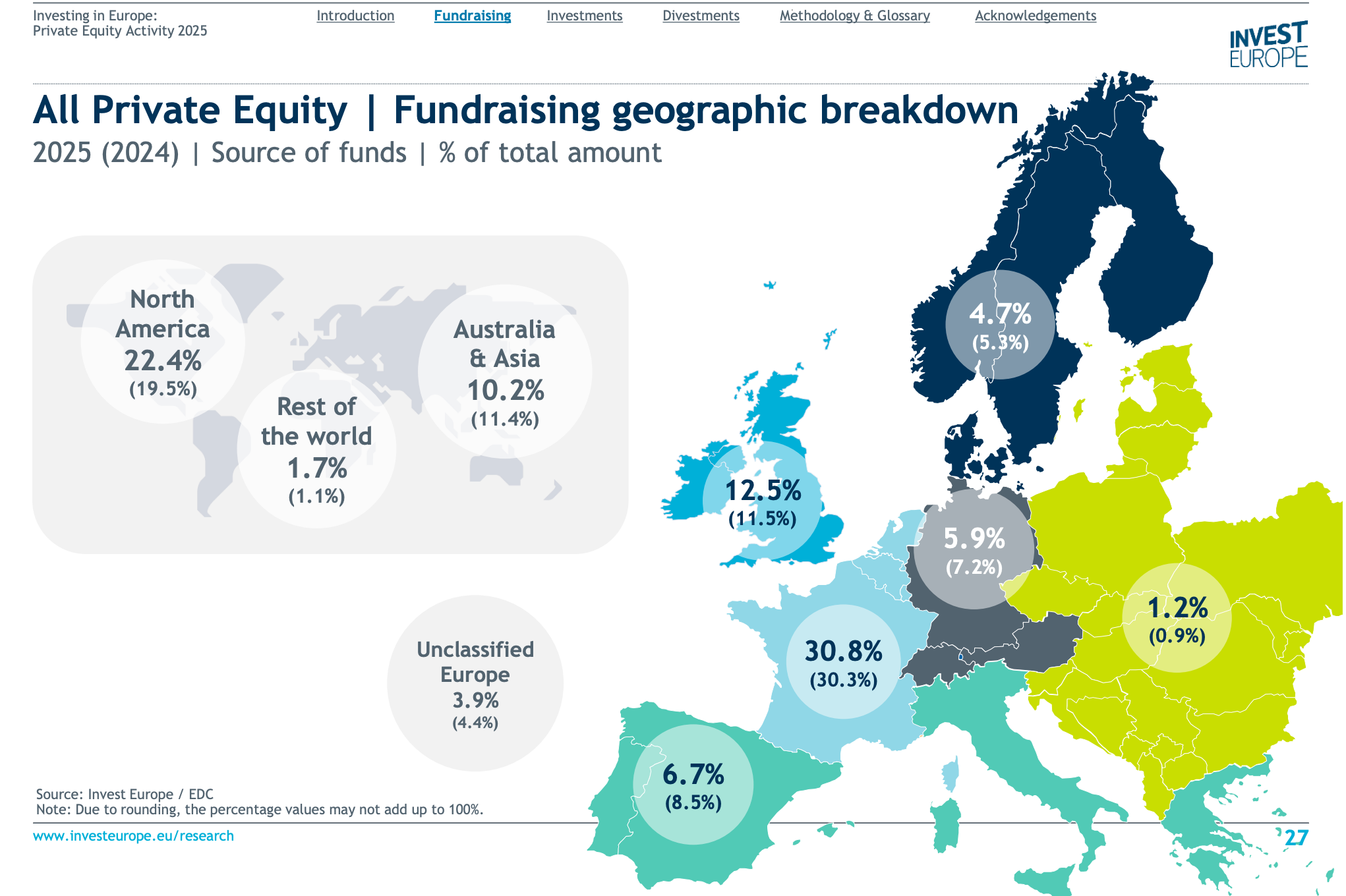
Europe still raises most of its own PE capital, but Invest Europe shows overseas investors supplied about 34% of the total in 2025 and about 45% of buyout fundraising. North America drove that: its buyout share rose to 29.6% from 23.6%, while Asia & Australia’s slipped to 13.4% from 15.7%.
The data don't show a uniform rush of foreign money into European PE: they show a particularly strong increase in North American appetite for European buyout. Temasek may be the hook, but US institutions are doing much of the heavy lifting behind the trends we see.
Main Capital Partners, the Dutch software-focused private equity firm, closed €5.25bn across two funds in June, both at hard cap and more than double the size of their predecessors.
Existing LPs re-upped at over 120%, while new investors came primarily from the US, Asia and the Middle East, including sovereign wealth funds, public pension funds and insurers. Named backers include the State Teachers’ Retirement System of Ohio, the Korean Teachers’ Credit Union and AkademikerPension. Main said the pace and scale were notable given the challenging fundraising environment.
In January, H.I.G. Capital closed its fourth European lower-middle-market fund at €1.6bn, up from the €1.1bn raised by its predecessor. It reached an oversubscribed first and final close within six months. Its LP base stretched across North America, Europe, the Middle East and Asia, including sovereign wealth funds, pensions, endowments and foundations.
On March 30, two more managers closed funds. Fremman Capital raised €808m plus €45m in associated managed accounts for its second mid-market fund, above its €750m target.
Investors came from five continents, and the firm pointed to significant new capital from new geographies. Inflexion closed Buyout Fund VII at its €4.5bn hard cap after six months in market, above an initial €3.75bn target.
The firm described the fund as heavily oversubscribed, with pensions, sovereign wealth funds, insurers, endowments and other institutional investors among the backers. Most of the capital came from existing investors, alongside over €1bn from new ones, and Connecticut committed up to €150m to the fund.
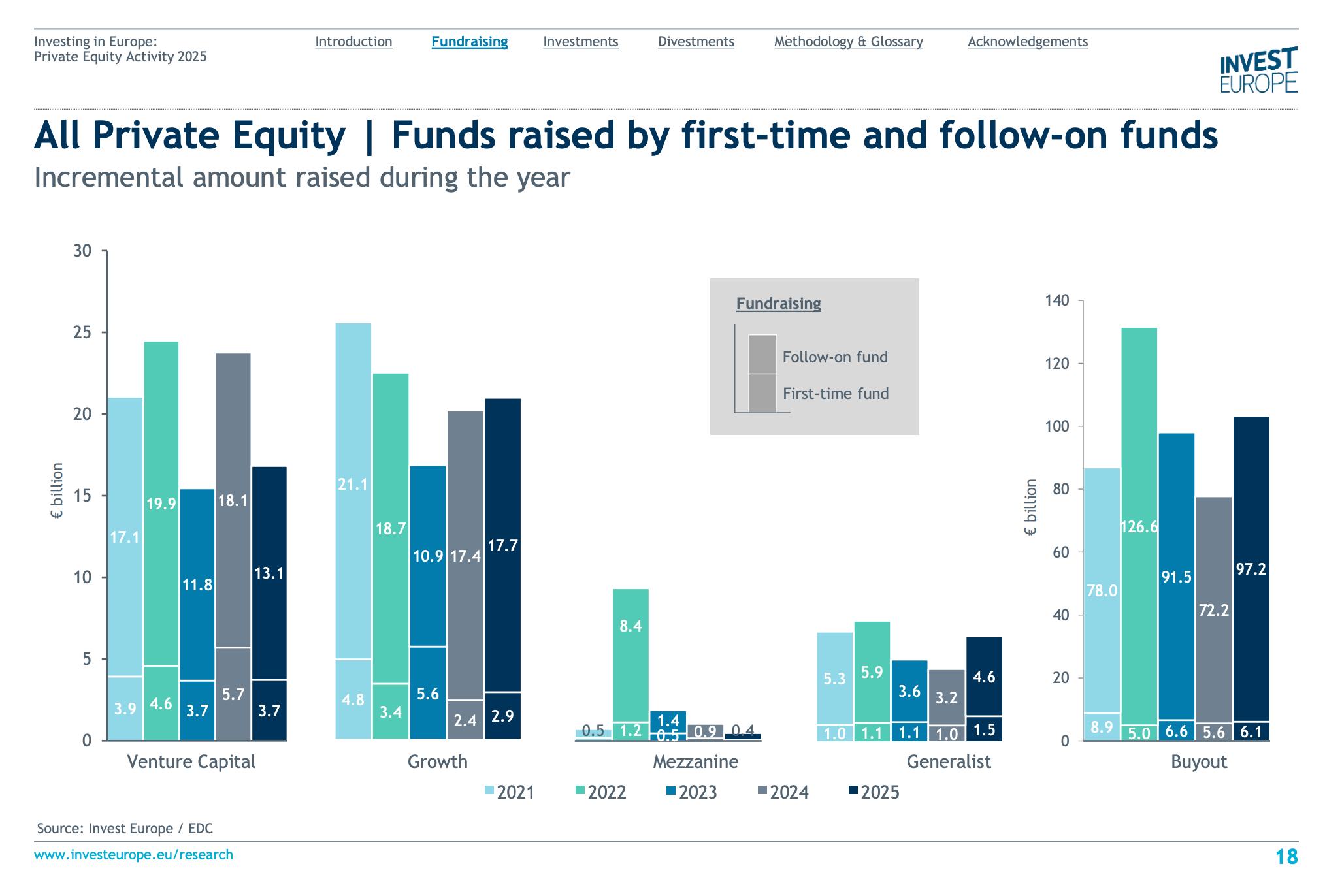
The pattern is that global newcomers are mostly joining established managers. In buyout, follow-on funds raised €97.2bn in 2025 against €6.1bn for first-time funds, about 94% of the total.
Why Europe? Why now?
LPs are still dealing with the consequences of weak distributions. PitchBook estimates that distributions were around 17% of NAV in 2025, well below the 10-year average of 26%. Nearly $5tn of NAV also sits in funds seven years or older, after three consecutive years of negative net cash flows for LPs.
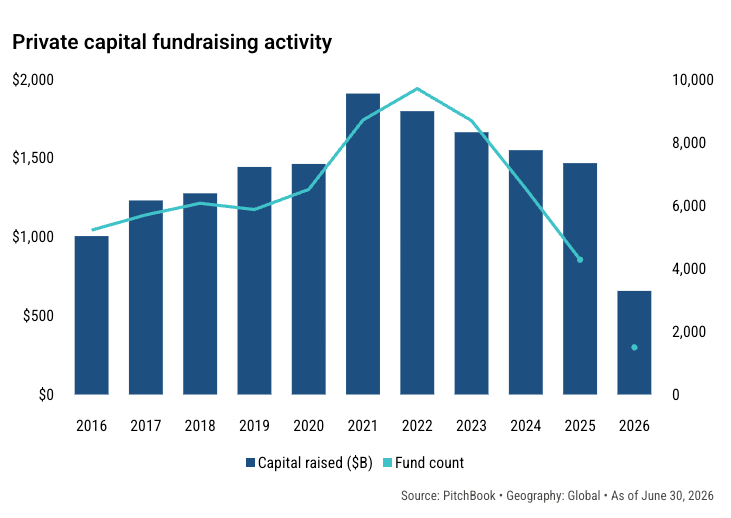
Less cash coming back means less money available for new commitments, which is why headline European fundraising has slowed. PitchBook counted €80.8bn raised by European PE funds in 2025, its lowest since 2015 and only 55% of the 2024 total.
Invest Europe counts capital raised in the year, including interim closes, which increased 16% to €147bn. But funds that actually reached final close tell a different story: buyout funds finishing fundraising in 2025 raised €75bn, down from €102bn in 2024, since last year's total was inflated by a handful of very large closes.
Funds between $1bn and $5bn increased their share of the market, a trend especially pronounced in Europe, where the largest fund closed in 2025 was CVC’s €4.6bn Strategic Opportunities III, against the vehicles of €26bn (CVC Fund IX, 2023) and €22bn (EQT X, 2024) in earlier years.
PitchBook data also show European mid-market funds ($1bn–€5bn) raised a record €53bn in 2025, up 35% — around two-thirds of all European PE fundraising.
Let’s continue the conversation in Milan!
The growing role of global LPs in European private equity raises a bigger question: how will these relationships evolve from here? And where better to explore it than Milan?
This week's deal happened in Milan, and so will the conversation. 0100 International 2026 takes place October 28–29 at Palazzo Castiglioni, bringing together roughly 700 LPs, GPs, and investors from more than 50 countries to discuss exactly how global capital meets local expertise.
We look forward to seeing you in Milan.