


This week, we’re looking at a question at the heart of a live allocation debate: can venture capital solve real-world problems, and can it do so at a return?
Venture has never had more capital or been less diversified. In Q3 2026, artificial intelligence took 64% of global venture funding. Healthcare, climate, food and education, which together account for trillions of dollars of annual spending, are competing for what is left.
That creates a pricing gap, and investors look for opportunity there. It also creates risk, because not every large problem comes with a buyer.
So instead of arguing the point, let’s look at where venture money is actually going, how healthcare, climate, food, and education compare, what the data says about impact and returns, and how Europe’s public and private capital are addressing the gaps.
Record capital. Record concentration.
Venture has more capital than ever, but it is concentrated in one theme and a handful of companies. For allocators, that is both a risk and a source of mispricing.
According to Crunchbase, global venture funding reached $159bn in Q3 2026 and $679bn over the first nine months, a record for that period. AI-driven startups raised $102bn in Q3, or 64% of the total. A record 27 companies secured rounds of $1bn or more, absorbing roughly one-third of the quarter’s funding.
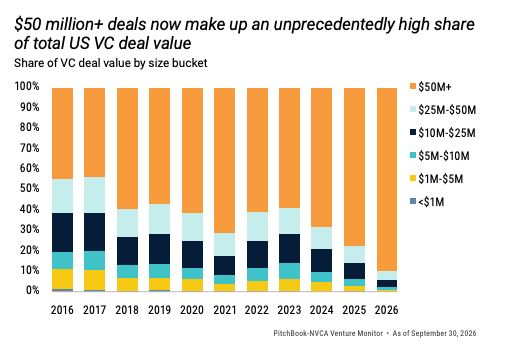
The concentration is even bigger in the US. PitchBook-NVCA reports $515.8bn in venture deal value through Q3, already 44% above the previous full-year record in 2021. AI companies captured 82.7% of that capital, while the 10 largest deals accounted for 68% of investment.
But deal value tells only part of the story. AI accounted for 65.9% of US venture dollars in Q3, compared with 44.9% of deals. Rounds of $100m or more represented just 5% of transactions but 75% of invested capital.
Venture is still funding thousands of companies; a relatively small group is capturing most of the money.
What this means beyond AI
The rest of venture has not stopped. Crunchbase reports that aerospace, robotics, data centers, semiconductors and energy each attracted at least $10bn globally in Q3.
Early-stage funding increased 25% year over year to $40.6bn, while seed investment reached $13bn. But some of these sectors are themselves benefiting from the AI infrastructure boom, rather than representing a shift away from it.
For investors looking beyond AI, healthcare, climate, food and education are worth a closer look. But the headline venture figures don’t show how much funding these sectors attract or whether their valuations are more attractive.
The data does show that capital is heavily concentrated in AI and large funding rounds. That raises an important question for investors: are strong businesses in other sectors receiving less attention?
The opportunity is to find companies with clear customer demand, sustainable business models, and valuations that leave room for attractive returns.
Where is venture going in the real economy?
Healthcare, climate, food, and education offer investors very different opportunities. Some are attracting record levels of capital, while others remain well below their funding peaks.
Across all four, investors are becoming more selective, directing capital toward companies with proven demand, clear revenue models, and the potential to scale.
Healthcare continues to attract significant venture investment, but capital is flowing to fewer companies. US digital health startups raised $11.1bn across 358 deals through Q3 2026, putting the sector on track for $14.8bn for the year.
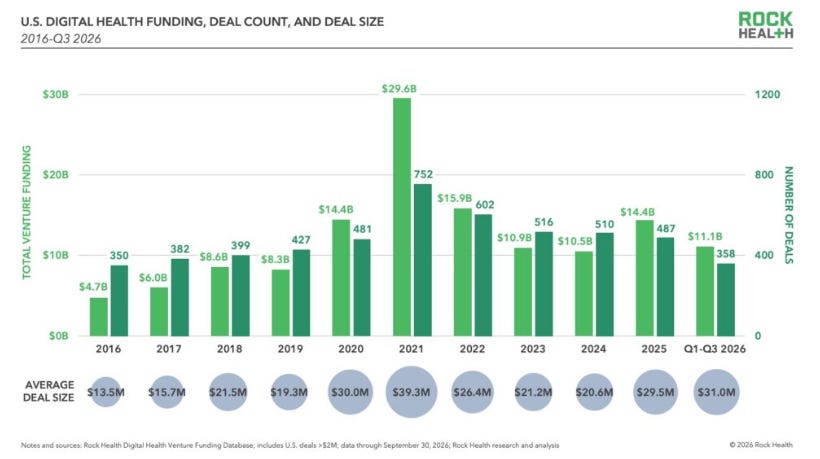
However, in H1, just 19 companies captured 45% of digital health funding through 20 mega-rounds. Mental health attracted the largest share of clinical venture funding for the seventh consecutive year, while biopharma raised $12.6bn in H1.
Europe is also seeing large healthcare deals. Sweden’s Neko Health secured $700m in July, while Tandem Health raised an €86.5m Series B.
African healthtech attracted $215m in 2025, up 232% year over year, yet the entire region raised less than a third of Neko Health’s single round.
Climate tech is seeing renewed investment, with energy demand driving much of the growth. Global funding reached $26.1bn in H1 2026, up 55% year over year.
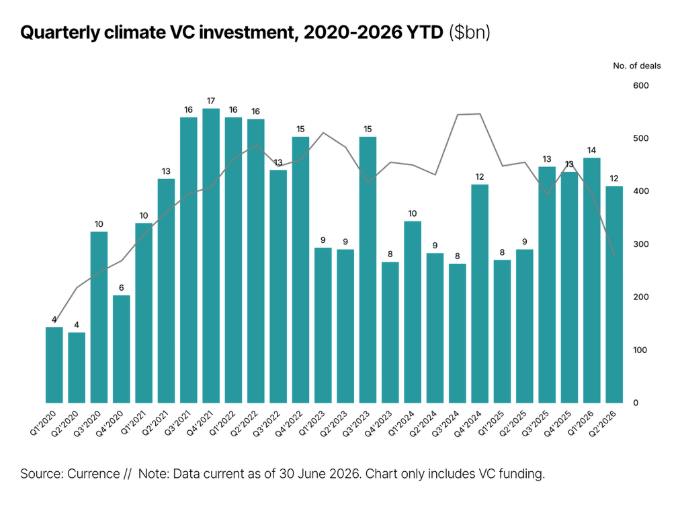
But the recovery is concentrated: deal count fell 25%, the 10 largest transactions accounted for 42% of funding, and low-carbon data centers alone attracted 34% of investment.
In Q3, climate funding totaled $19.6bn across 686 deals, the lowest deal count since 2021. Nuclear, geothermal, and energy storage continued to attract capital, while carbon removal funding dropped 61% and low-carbon fuels fell 56%.
Europe offers a different investment landscape: climate tech accounted for 15.1% of European venture funding in 2026, compared with 4.4% in the US.
The numbers suggest investors favor technologies tied to immediate energy and infrastructure needs, while other climate solutions face a tougher fundraising market.
Education has seen the biggest pullback in venture funding, but investment is shifting toward workforce skills and AI-enabled learning.
Global edtech investment fell from $20.8bn in 2021 to $2.4bn in 2024, an 89% decline. Funding edged up to $2.6bn in 2025, but H1 2026 investment fell to $1bn, down 26% from the previous year.
The areas still attracting capital offer a clearer link to employment and productivity. In Q1 2026, more than 70% of edtech funding went to workforce training.
Europe: more mission capital than the US
Europe has been a strong market for investing in climate, energy, and other real-world challenges. But as venture funding grows, AI is attracting an increasing share of that capital, raising questions about how much remains available for other sectors.
In 2025, climate and energy accounted for 18% of European venture funding, the highest share globally. However, that share had fallen from 32% in 2023.
Meanwhile, deep tech attracted 36% of European venture capital, up from 19% in 2021.
Europe is also using public capital to support growing companies. The Scaleup Europe Fund has backed six companies, including ICEYE, Mistral, The Exploration Company, and Tandem Health. These investments show how public capital can support companies in healthcare, space, and advanced technology, although it is still too early to assess the fund’s impact.
The bigger opportunity may be in unlocking long-term capital. Atomico estimates that European pension funds could bring an additional $210bn into venture over the next decade if their allocations matched those in the US.
That could help address Europe’s scale-up funding gap and give more companies the capital they need to grow.
Let’s continue the conversation in Milan!
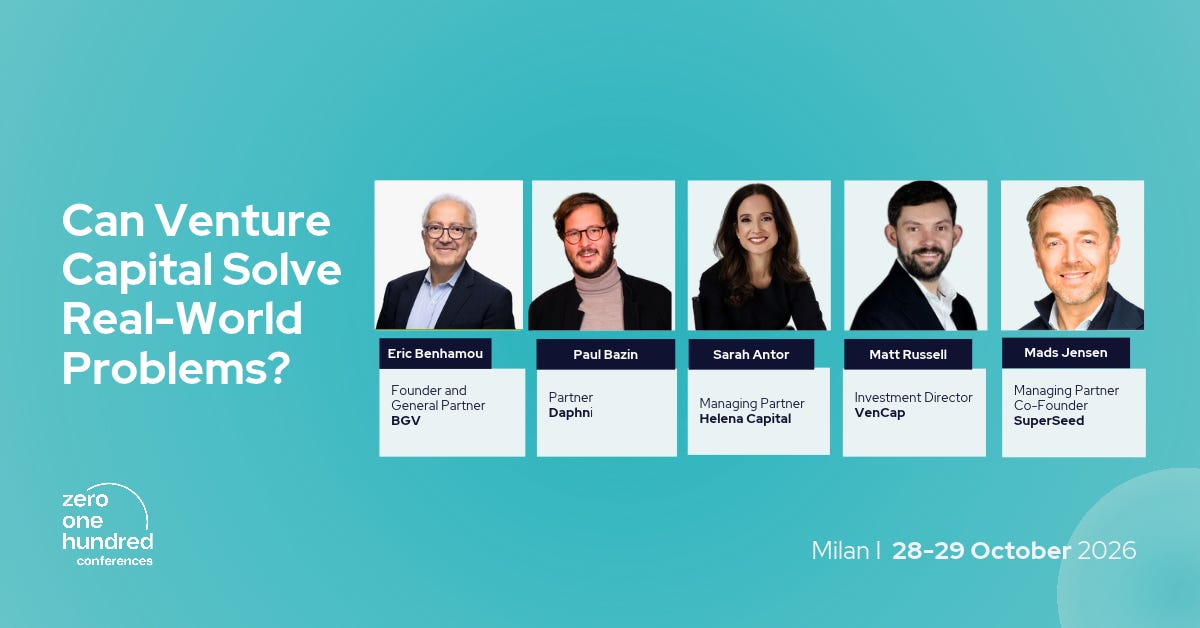
With so much venture capital flowing into AI, where does that leave startups working on healthcare, climate, food, and education? And how can investors support these businesses while still generating attractive returns?
These are some of the questions we’ll explore at 0100 International in Milan, where we’ll explore how venture capital can address real-world challenges while creating investment opportunities.
The discussion will bring together Eric Benhamou (BGV), Paul Bazin (daphni), Matt Russell (VenCap), and Sarah Antor (Helena Capital), moderated by Mads Jensen (SuperSeed). Together, they’ll share their perspectives on investing in innovation across healthcare, food security, education, and climate resilience.
This is a truly insightful post. I have mixed feelings about the investment landscape you describe. While it is encouraging to see substantial capital flowing into European companies, your distinction between record funding and a less diversified market highlights my main concern: are we financing a broader innovation ecosystem, or simply concentrating more money in fewer companies?
I would add a European early-stage perspective to your global funding figures. The number of European seed deals fell by 44% even though total venture investment rose by almost 30%. This highlights why rising investment alone do not indicate whether the startup pipeline is healthy.
Your discussion of European pension capital resonates with me. EU scale-ups remain heavily dependent on non-EU lead investors. Unlocking more domestic long-term capital could help, but I would want to see a stronger financing pipeline, from the first cheque through to growth, not just more capacity for the largest rounds. Otherwise, we risk addressing the scale-up gap while overlooking the companies that could become tomorrow's scale-ups.
Finally, I would extend the diversification question to AI itself. As well as investing beyond AI, there is a case for allowing different approaches within it to flourish, including world models and applications focused on physical reasoning and planning. The broader advantages of these approaches remain unproven, but Europe’s opportunity need not be limited to replicating the largest US model developers.
How Europe can finance a wider range of commercially viable solutions from their earliest stages through to scaling up?