


Hello there,
This week, we’re looking at the EU’s €5bn Scaleup Europe Fund, and the two deals it has picked to introduce itself.
Few vehicles have carried as much political weight into their first transactions. The fund exists because Europe keeps producing world-class companies and then watching them get priced, owned, and eventually acquired by American capital as they scale. Its first two moves, though, have investors asking whether it’s actually solving that problem, or just co-signing deals that were already done.
Last week, Lovable raised $400m at a $13.3bn valuation, led by existing investor Menlo Ventures, with Balderton Capital joining the cap table and the Scaleup Europe Fund co-leading.
Three weeks earlier, the fund made its actual debut: a €450m primary check into satellite operator ICEYE’s €1bn Series F, at a valuation north of €10bn.
Two-for-two, and neither needed the money
Both rounds closed the same way: oversubscribed, led by marquee private investors, and priced without any help from Brussels. ICEYE’s raise came alongside General Atlantic.
Lovable’s came alongside Menlo Ventures, Balderton, and a cap table that already included CapitalG, Salesforce Ventures, DST Global, and Khosla Ventures from earlier rounds. The company hit $500m in ARR in June and was targeting a 65% margin by H2 2026 well before the fund showed up.
That’s the pattern a number of investors have started flagging publicly: the fund’s first two checks went to the companies least likely to need one.
The Scaleup Europe Fund targets €5bn, roughly €1bn of public capital from the EU’s Horizon Europe program, the rest from private anchors including Novo Holdings, Denmark’s EIFO, CriteriaCaixa, Santander/Mouro Capital and the Wallenberg family.
EQT manages it and is mandated to write €100m+ checks to Series B-to-pre-IPO companies across AI, quantum, semiconductors, robotics, dual-use technologies, clean energy, space and biotech (Vestbee).
Unlike a traditional EU grant program, it isn’t run by public officials picking winners. It operates like a private growth fund with a commercial return target, hired out to a market-based manager, a structure meant to keep politics out of underwriting.
The battle isn’t over funding. It’s over the cap table.
The strongest defense of the fund’s first two investments is not that Lovable or ICEYE needed help raising capital. Clearly, they didn’t. The argument is that access to capital was never the only problem the fund was designed to solve. But it's also about who provides the capital and who owns Europe’s most valuable companies.
From that perspective, an oversubscribed round is not necessarily evidence that public-backed capital has no role. In fact, it may be where the sovereignty argument matters most. Europe’s strongest scaleups naturally attract the deepest pools of global growth capital, much of it from the US.
As those companies raise larger rounds, European ownership can gradually be diluted, leaving some of the continent’s most strategically important businesses increasingly controlled by investors outside Europe. That creates the longer-term risk policymakers are trying to address:
European companies can remain headquartered and built in Europe while their ownership, financing, and exit paths move across the Atlantic.
Before the Lovable deal, reports indicated EQT was also in talks to co-lead Mistral AI’s €3bn Series D at a roughly €20bn valuation, a third high-profile, well-capitalized name that has never struggled to raise. If that deal lands, the fund’s opening moves will follow the same logic: back the companies most likely to end up fully US-owned first, because those are also the companies with the most to lose.
If Mistral ultimately joins Lovable and ICEYE in the portfolio, the fund’s early strategy becomes much clearer. It is starting with the companies that need European money the least, but may matter most for European ownership.
That may be a legitimate use of sovereignty capital, but it comes with an opportunity cost.
Every euro invested in a company already attracting the world’s largest investors is a euro that cannot go toward building the next Lovable or ICEYE.
The gap the fund was built to close, by the numbers
The urgency behind that logic is real, even if the first two deals don’t obviously address it.
VC funds domiciled in the EU manage roughly €150bn combined, against roughly €930bn for US-based funds — a 6x gap concentrated specifically at later stages (ECB).
Europe has produced 48 tech companies valued above $10bn, versus 206 in the US. At the $100bn+ tier, the count is five against twenty-three (State of European Tech).
European venture funding is more concentrated than ever: H1 2026 saw €44.1bn raised, but the number of companies actually getting funded fell to a six-year low, with rounds above €100m accounting for more than half of total deal value (Tech.eu).
For the sectors named directly in the fund’s mandate, the picture is even starker. Europe hosts an estimated 5% of global AI compute capacity, compared with roughly 75% in the US, and annual private AI investment in the US runs at about 24x that in Europe (Digitimes; TechPlusTrends).
McKinsey also projects European data-center demand tripling from 10 GW to 35 GW by 2030, capacity that doesn’t yet exist, and costs more to build in Europe than the US equivalent.
That’s the gap the fund’s mandate points to. So far, its checks haven’t followed it there.
Europe is building a sovereignty capital stack
The Scaleup Europe Fund is only one part of a much larger European experiment with public-backed capital. Across the continent, governments and EU institutions are building investment vehicles designed to address the same structural weakness:
Europe produces technology and talent, but still lacks the depth of capital needed to finance both at scale.
The EIF is launching a $17.5bn fund-of-funds to strengthen the growth-stage VC market across roughly 100 funds. The UK's Sovereign AI Fund, launched in April 2026, takes a more targeted approach, focusing on areas where private investors may be reluctant to absorb long time horizons and high upfront costs, including compute infrastructure, defense, and public-sector AI.
The instruments are different, but the underlying logic is similar: public capital should change an outcome the private market would not produce on its own.
That could mean unlocking infrastructure, absorbing early risk, creating larger pools of domestic growth capital, or keeping strategic companies anchored in Europe.
Let’s Continue the Conversation at 0100 Emerging Europe!
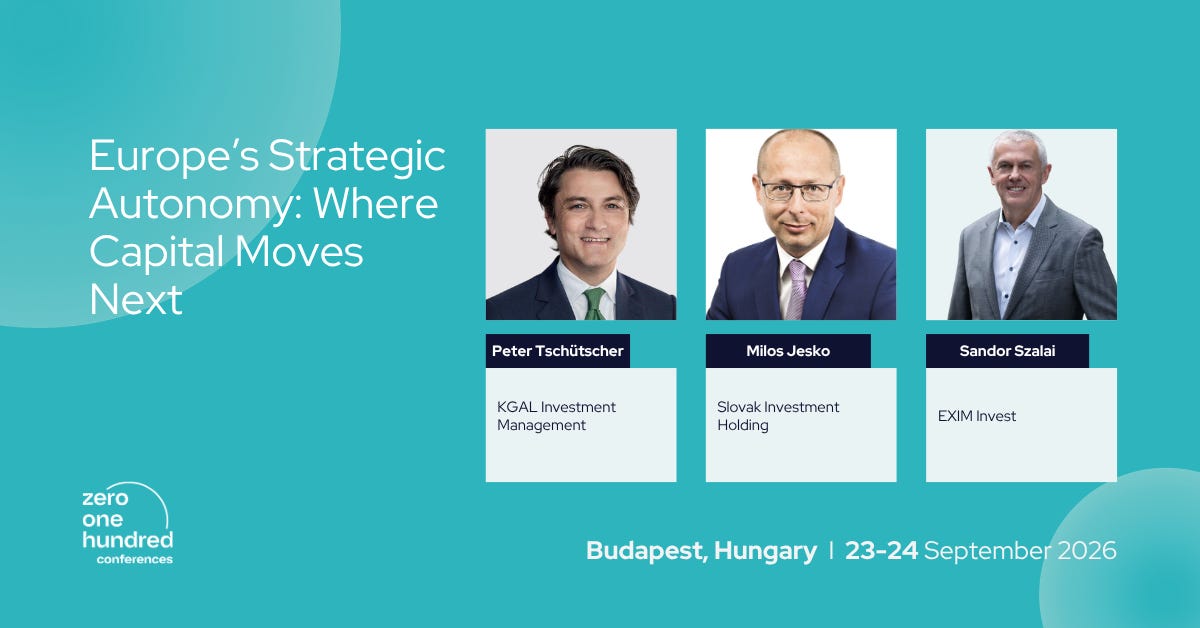
Europe’s push for greater strategic autonomy is influencing where private capital sees opportunity. As governments prioritize defense, energy security, AI, critical infrastructure, and industrial resilience, investors are looking at sectors once viewed primarily through a policy lens.
At 0100 Emerging Europe, Peter Tschütscher of KGAL Investment Management, Milos Jesko of Slovak Investment Holding, and Sandor Szalai of EXIM Invest will explore where that capital is likely to flow next, how geopolitical priorities are changing investment strategies, and what it means for Emerging Europe.
With its industrial base, energy needs, defense capabilities, and growing technology ecosystem, the region could become one of the key beneficiaries as European sovereignty moves from a policy ambition to an investment theme.