

From Value Creation to Value Preservation: When Good Businesses Become Difficult Investments for PE Firms — 0100 Weekly Brief


Hello there,
Last time, we looked at how private credit is starting to show signs of stress as liquidity tightens and investor behavior changes.
This time, the story starts with a cup of tea, and the recent news about CVC Capital Partners injecting €210M into the struggling tea business offers a more tangible lens into how those pressures translate at the asset level.
Lipton is struggling under a heavy €3.2 billion debt load, with its loans trading at distressed levels and investors demanding high yields to hold them. Revenues have declined significantly, falling from around €2 billion before the carve-out to €1.57 billion in 2024, reflecting both weaker demand and portfolio changes.
Traditional black tea consumption is also declining in key markets such as the UK, as consumers shift toward coffee and other beverages, adding further pressure on the business.
This is why CVC Capital Partners is now adding €210 million into the former tea business it acquired from Unilever for €4.5 billion, as performance deteriorates and concerns grow over a potential debt restructuring.
The challenges have been compounded by a more complex-than-expected separation from Unilever, underinvestment in the brands, rising costs following global inflation shocks, and management turnover. Analysts and restructuring advisers increasingly view the capital structure as unsustainable, with leverage levels far above what is typical for stable consumer businesses.
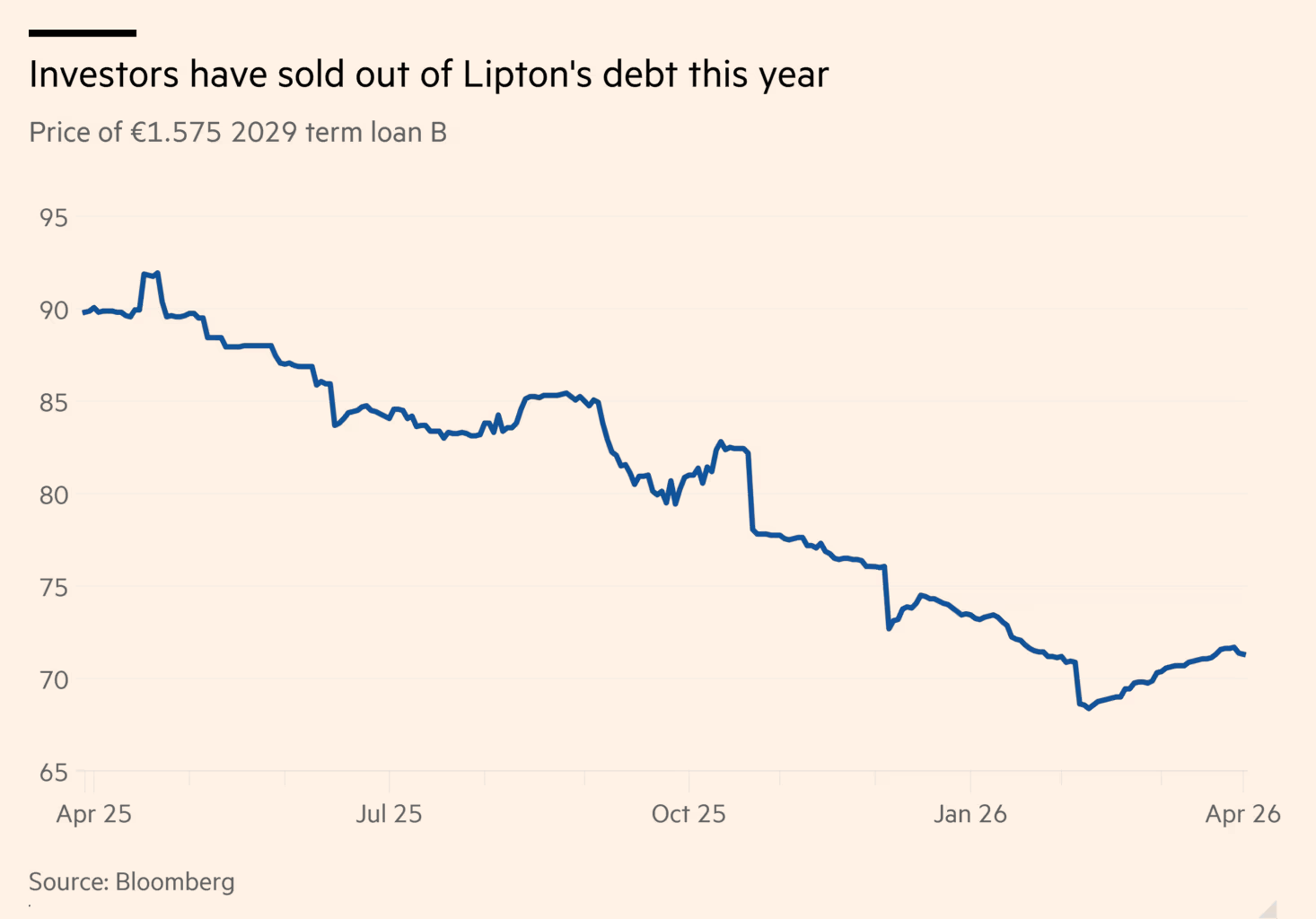
While new leadership is pursuing a turnaround focused on growth areas like herbal teas and e-commerce, many investors remain skeptical, with some already positioning for a potential restructuring. Overall, the situation highlights the risks of applying high leverage to slow-growth, legacy consumer brands in a more challenging economic environment.
A Familiar Pattern Across Asset Classes
While Lipton may appear deal-specific, the underlying dynamics are not. Across sectors, similar situations are emerging, particularly in businesses acquired during a period when leverage was both abundant and inexpensive. The common factor is not necessarily disruption, but rather limited room to absorb it.
In retail, Hudson’s Bay, a company with more than three centuries of operating history, entered creditor protection carrying close to $1 billion in debt at the beginning of last year. The business faced multiple external pressures, but leverage played a central role in constraining its ability to respond effectively.
Payless followed a comparable trajectory many years ago. After being taken private, successive rounds of leverage and dividend recapitalizations reduced financial flexibility to the point where liquidation of 2,500 stores became inevitable. In both cases, the challenge was not simply declining performance but the inability to adapt within the confines of the capital structure.
The Cost Side of the Equation
Operational optimization has long been a core lever in private equity value creation. In many cases, it remains highly effective, particularly where inefficiencies are clear and addressable. But recent examples suggest that its limits are becoming more visible in certain contexts.
Kraft Heinz provides another good illustration. After years of aggressive cost-cutting under private equity ownership, the company has recently announced a change in strategy, with its new CEO acknowledging that reductions went too far and weakened core capabilities. The impact was not only operational but also strategic, affecting the company’s ability to innovate and maintain relevance.
Cost discipline can improve margins in the short term, but beyond a certain point, it begins to erode the very capabilities required for long-term performance. In mature or slowly evolving industries, where growth is not easily generated, that trade-off becomes more pronounced.
Alongside operational considerations, deal structuring has also evolved in ways that affect how outcomes are realized and distributed. The increasing use of continuation vehicles, for example, has provided sponsors with additional flexibility around exits and capital recycling.
The case of Wheel Pros illustrates both the benefits and the risks. Clearlake Capital generated nearly $1 billion in profit through a series of transactions, including a continuation vehicle, before ultimately filing for bankruptcy with a $1.7 billion debt load. As noted by the Financial Times, the business was spending approximately $170 million annually on interest against $69 million of operating profit.
What stands out is not just the outcome, but how it was distributed. Early investors realized gains, while later-stage participants absorbed losses as performance deteriorated. In more complex structures, the timing of entry and position in the capital stack increasingly determine outcomes, sometimes more than the underlying asset itself.
Lipton sits at the intersection of these dynamics. It is a global brand with scale and recognition, but operating in a category undergoing gradual change. At the same time, it carries a capital structure that limits its ability to absorb prolonged underperformance.
The response so far has been management changes, portfolio refocusing toward higher-growth segments such as herbal teas, and incremental capital injections, all following a familiar playbook. These actions may stabilize the business, particularly if execution improves and demand trends change in its favor.
The more fundamental question, however, is whether stabilization alone is sufficient. In highly leveraged situations, incremental improvements may not translate into meaningful deleveraging. And without that, the range of strategic options remains limited.
A Question of Cycles, Not Exceptions
There are two ways to interpret the current environment. One is to view these as isolated situations, individual deals affected by specific sector dynamics, execution challenges, or timing.
The other is to see them as part of a broader cycle. Many of these assets were underwritten in a period characterized by low interest rates, abundant liquidity, and strong exit optionality. Those conditions supported higher leverage and tighter margins for error.
As the environment changes, those assumptions are being tested. What appears today as deal-specific stress may, in aggregate, reflect a broader repricing of risk across leveraged equity.
For private equity investors, the implication is not that the model is fundamentally impaired. The core principles, active ownership, operational improvement, and disciplined capital allocation, remain intact.
What is changing is the degree of selectivity required. Entry price discipline, capital structure resilience, and the ability to drive genuine operational change are becoming more critical determinants of outcome.
In that sense, the current environment is less about disruption and more about normalization. A reminder that leverage amplifies both upside and downside, and that the latter becomes more visible as conditions tighten.
New Sources of Value: AI as Infrastructure
But while parts of the market are adjusting to tighter conditions, we see another dynamic emerging at the intersection of private equity and AI, one that may redefine where value will go.
Anthropic has partnered with Blackstone, Hellman & Friedman, and Goldman Sachs to launch a new enterprise AI services firm, backed by a broader consortium including General Atlantic, Apollo, GIC, and Sequoia. The platform is designed to deploy AI directly into the operations of portfolio companies, embedding engineering capabilities alongside capital to accelerate adoption at scale.
Rather than relying solely on operational improvements within individual assets, sponsors are increasingly positioning themselves as distributors of technology across their portfolios. In that context, AI is not just a tool for efficiency, but a layer of infrastructure, one that can influence growth, margins, and ultimately valuations.
The implication is that access, implementation, and control of AI deployment may become as important as traditional levers such as leverage and cost discipline.
🌍 Across the Ecosystem | From Value Creation to Value Preservation
Sponsors, credit investors, and institutional LPs are increasingly focused not just on how value is created but also on how it is preserved, particularly in assets underwritten in a very different environment. The recent developments around Lipton are one example of this transition, but this is not an isolated case.
Recent developments across the market illustrate this from multiple angles. In some cases, such as Breitling, valuation expectations are being reset as growth slows and cost structures become harder to sustain. In others, capital continues to flow, as seen in Ares’ financing of consumer brand consolidation, but with a clearer emphasis on resilience and cash flow visibility.
Value creation remains an important part, but it is accompanied by a second priority: preserving value in a more constrained environment, where growth is less predictable, and capital structures matter more.
🗞️ News | CVC explores a potential deal for Nexi, a heavily indebted payments company facing investor skepticism
CVC Capital is exploring a potential €9 billion ($10.5 billion) acquisition of Italian payments group Nexi, marking a possible return to a deal it has previously considered multiple times.
The discussions are still at an early stage and may not result in a formal offer, but they come at a time when Nexi’s shares have fallen to record lows amid investor concerns about its strategy and performance. The company is also operating with around €6 billion in debt, which would add complexity to any potential transaction.
🗞️ News | Private equity owners slash valuation of Swiss watchmaker Breitling
Breitling’s private equity owners, CVC and Partners Group, have cut the valuation of the Swiss watchmaker to as little as half its 2023 level, as performance has weakened following a period of rapid expansion.
The brand has struggled with an expensive store rollout, softer demand for luxury watches, and external pressures such as US tariffs, leading to slower sales growth and declining earnings. Estimates suggest revenues fell around 3% last year, with particularly weak performance in key markets like the UK, while increased fixed costs from retail expansion have further compressed profitability.
🗞️ News | Ares Leads $1.6 Billion Debt Financing for Personal-Care Product Merger
Ares Management has led a $1.6 billion debt financing package to support the merger of personal-care brands Suave Brands and Elida Beauty, both backed by consumer-focused private equity firm Yellow Wood Partners.
The transaction will combine the two businesses into a new entity, Evermark, bringing together a portfolio of established consumer brands under a single platform.