


Hello there,
For years, conversations around venture capital have focused on growth, innovation, and opportunity. Europe’s startup ecosystem has expanded rapidly, producing new technologies, ambitious founders, and an increasingly sophisticated investor base. Yet beneath this momentum lies a quieter imbalance—one that becomes clearer when we look closely at who is building companies and who is allocating capital.
Women remain significantly underrepresented across the venture landscape. The gap is visible not only in funding statistics but also in industry leadership. Even at our own conferences, where we aim to include at least one female voice on every panel, reality sometimes makes that goal difficult to achieve.
The numbers help explain why. Women hold only about 14% of partner-level roles in venture capital firms and represent roughly 10% of startup founders. The disparity becomes even more pronounced as companies scale and funding rounds grow larger.
A similar pattern exists in private equity. As of early 2026, women hold an estimated 11–15% of senior investment roles globally, highlighting how slowly representation changes at the top levels of capital allocation.
The funding gap is even more striking. All-female founding teams receive just 3% of venture investments below €10 million and only 0.88% of investments above €10 million, suggesting that access to capital narrows further as companies move into later stages of growth.
Today, we take a closer look at what sits behind these numbers—and what they reveal about how capital flows across Europe’s venture ecosystem.
Europe’s Gender Investment Gap Still Holding Back Growth
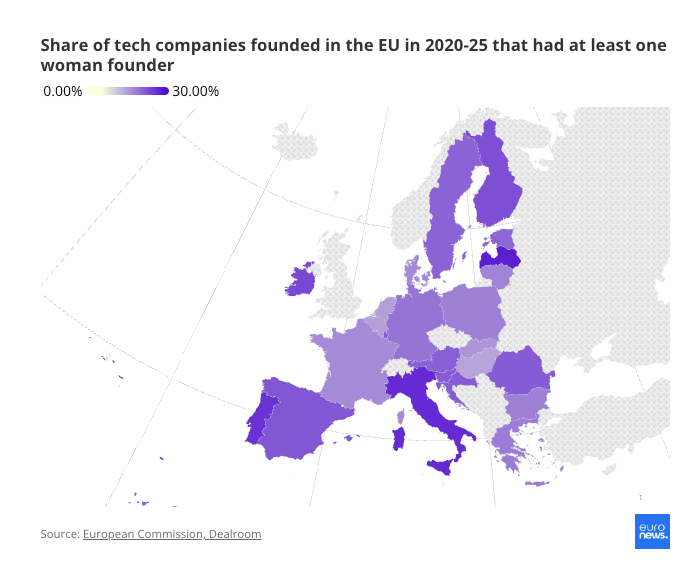
A report from the European Commission highlights a significant gender investment gap across Europe, with only about one in five tech startups founded between 2020 and 2025 including at least one woman. Even when women are involved as founders, their companies tend to receive less funding than those led by men.
The share of startups with female founders varies widely by country, with Latvia, Italy, and Portugal showing the highest levels of gender diversity, while countries like the Czech Republic and Hungary remain far below the European average. Closing this gap could have a major economic impact, potentially increasing EU GDP by about €600 billion by 2040.
The disparity extends beyond venture capital.
Female-owned small and medium-sized businesses are less likely to receive bank loans, even when company size and sector are similar.
Experts attribute the gap to several factors, including lower representation of women in investment decision-making, societal expectations around caregiving, and limited access to entrepreneurial networks. At the same time, women control a growing share of personal wealth in Europe, which could unlock trillions of euros in additional investment if participation matched that of men. However, structural biases and geographic disadvantages continue to limit women’s access to capital across the region.
Another important insight from the report is how capital allocation within the venture ecosystem reinforces the funding gap. Women remain significantly underrepresented among investors themselves, making up only about 15–17% of General Partners (GPs) in European venture capital firms, and an even smaller share of Limited Partner investment committee members.
The report also highlights the large economic opportunity lost due to this imbalance. Evidence shows that startups founded or co-founded by women can generate 10% more cumulative revenue per euro invested than those founded only by men, while female-led firms often demonstrate stronger ESG performance and workforce development. At a broader level, closing the gender investment gap could unlock hundreds of billions of euros in economic value, potentially adding between €250 billion and €600 billion to EU output over time.
Female Founders Still Struggle to Secure Venture Funding in Europe
Despite a small increase in the number of women making investment decisions at European venture capital firms, female-founded startups are receiving less funding overall.
According to PitchBook, women now make up a slightly larger share of VC decision-makers—13% at smaller funds and 16.5% at larger firms. However, this growing representation has not translated into more capital for women-led companies.
In fact, funding for female-founded startups fell for the fourth consecutive year in 2025, with women raising €9.5 billion, more than 15% less than the previous year. Their share of total deal value also dropped to 16.5%.
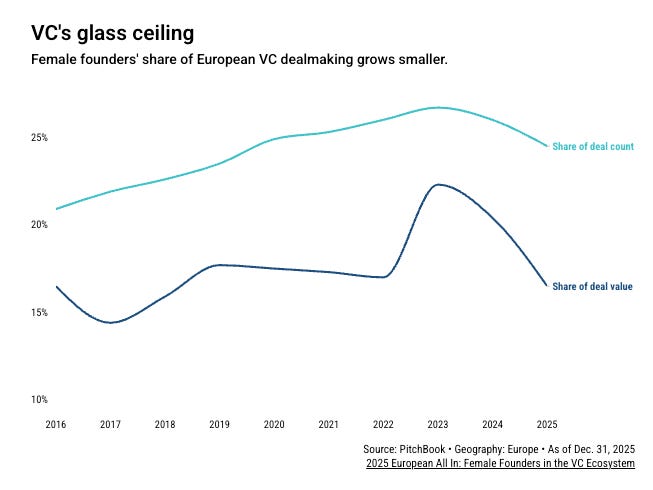
Meanwhile, male-founded startups saw deal values grow, widening the funding gap. Even in booming sectors like AI, women-led companies captured only a small portion of investment—about €3 billion out of €23.5 billion total. Some sectors show stronger representation, particularly life sciences and femtech, where funding improved and several notable exits occurred.
Still, overall data suggests that increasing diversity among investors alone has not yet solved the broader funding imbalance facing female founders in Europe.
What is The Real Perspective From The Founder’s Side?
Four female startup founders argue that International Women’s Day in the tech and startup world often feels performative rather than meaningful. They say the celebration tends to highlight “female founders” as a special category instead of treating them simply as entrepreneurs.
While well-intentioned events like women-only panels, networking breakfasts, and mentorship groups exist, the authors believe these initiatives don’t solve the real issue: women still lack consistent access to the main networks, relationships, and decision-making spaces where funding and business opportunities actually happen.
A Women Perspesctive: Building the Foundations of the AI-Native Economy
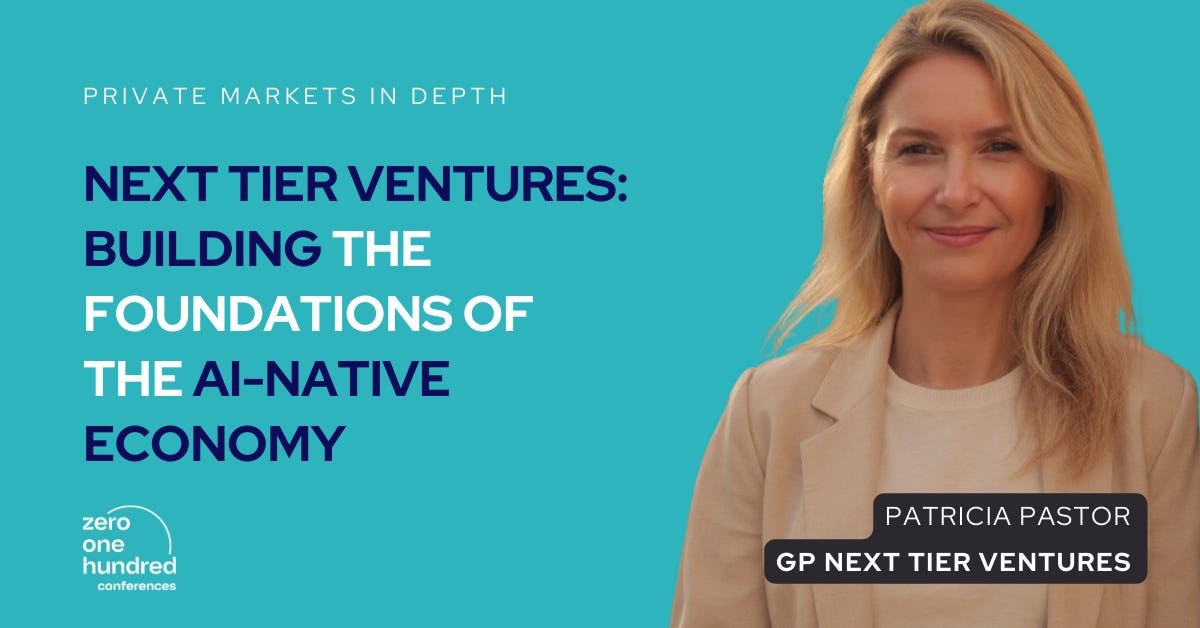
As venture capital continues to evolve, new technologies like artificial intelligence are shaping how investors evaluate startups. In our latest interview, we spoke with Patricia Pastor, General Partner at Next Tier Ventures, about how AI is changing the way software companies are built.
Patricia focuses on backing founders building AI-native companies, where artificial intelligence is not just a feature but the core of the product. She explains how investors today are looking for teams that can build strong technology, protect their data, and create businesses that can scale over time.
Her perspective also connects to a broader conversation about who gets access to capital in today’s ecosystem. As AI becomes one of the most competitive sectors in venture capital, the expectations for founders are rising. Patricia shares what she looks for in early-stage teams, how investor thinking around AI has matured, and where she sees the most promising opportunities ahead.
In a market where capital and attention are increasingly concentrated in a few sectors, voices like hers offer an important view on how innovation, talent, and investment decisions shape the future of entrepreneurship.
Join the Discussion about The AI Gold Rush at 0100 Europe in Amsterdam

The discussion explores how investors can separate real enterprise value from hype in Europe’s fast-growing AI ecosystem. As AI attracts large amounts of capital and attention, the discussion focuses on where meaningful opportunities are emerging, how AI is being adopted across industries, and what signals investors should look for when evaluating companies building long-term value.
Bringing together investors and operators from firms including Global Ventures, Partech, Eight Roads, Andreessen Horowitz’s a16z Perennial platform, and TechTorch, the panel also addresses the practical realities of investing in AI in Europe. Our panelists examine major market trends, the role of enterprise adoption, and the factors that differentiate durable AI businesses from short-term momentum.
🌍 Across the Ecosystem | News & Useful Resources for You
We’re not the only ones exploring the challenges and opportunities shaping women’s participation in venture capital and entrepreneurship. Across the innovation ecosystem, more researchers, investors, and founders are examining the structural factors behind the gender funding gap and questioning how capital is allocated across the startup landscape.
Here’s a spotlight on recent reports, articles, and perspectives that shed light on gender diversity in venture capital.
📄 Article | 21 female founders and operators to watch in the Nordics
Although women remain underrepresented in startup founding teams, a new wave of female founders and operators is beginning to reshape the ecosystem.
Sifted identified 21 women across the Nordics who are building influential startups or playing key roles in scaling major tech companies, highlighting the growing presence of women across sectors such as AI, healthtech, climate tech, fintech, and developer tools.
📝 Report | CVC does better than the rest of VC in gender balance
Corporate venture capital (CVC) appears to be making more progress on gender diversity than the broader venture capital industry. According to a recent Global Corporate Venturing benchmarking survey, about 43% of CVC teams are either gender-balanced or majority female, compared with only 31% of teams in the wider VC sector.
Despite this progress, gender inequality still exists within the industry, particularly at senior levels. Women are more commonly represented in early-career or mid-level positions, while leadership roles remain heavily male-dominated.