


Hello there,
Last week we hosted our traditional Italian gathering to officially launch 0100 International 2026, happening October 28–29 in Milan next month.
We brought together two of the largest Italian VC funds: Lisa Di Sevo, Managing Partner of PranaVentures and Prana101, and Giulia Giovannini, Partner, Early Stage, at United Ventures; as well as Francesco Cerrutti, Director General of Italian Tech Alliance, the association that brings together the entire entrepreneurship and investor ecosystem in Italy, and Layla Pavone, Head of the Board for Technological Innovation and Digital Transformation of Milan. The conversation was moderated by Bloomberg's reporter, Antonio Vanuzzo. Below, the full insights.
Dealroom currently tracks around 760 funded startups in Milan's ecosystem, and the city accounts for a significant share of Italy’s most valuable venture-backed companies. Institutions including Bocconi University, Politecnico di Milano, the University of Milan, and Milano-Bicocca also contribute to a strong pipeline of founders, research, and talent.
Zooming out, Italy now has 2,000 VC-backed companies with a combined enterprise value of around $60 billion. Importantly, companies launched in the past decade already account for roughly one-third of that value, showing how much of the ecosystem has been built relatively recently.
The broader Italian market is also growing. Italian venture capital fundraising reached €1.48 billion in 2025, up 32% year over year, with particularly strong activity in deep tech, health and life sciences, and software and digital services. At the regional level, Lombardy is also investing more in the ecosystem, including an additional €30.9 million for Lombardia Venture STEP in 2026 to support VC investment in deep tech, biotech, and clean tech startups and scaleups.
The Gap and the Opportunity
Italy’s venture ecosystem remains meaningfully smaller than its European peers. The gap looks even more striking relative to Italy's economy. Italy represents around 11% of European GDP, but just 1.7% of Europe’s VC-backed enterprise value. In other words, the issue is not simply that Italy trails larger venture markets; its technology ecosystem remains small relative to the economic base underneath it.
According to Italian Tech Alliance’s observatory with Growth Capital, Italian startups raised roughly €1.7bn in 2025, compared with €2.3bn in Spain, €7.7bn in France, and €21.6bn in the UK.
The first half of 2026 has continued that trajectory, with €813m invested across 145 rounds nationally. Lombardy, and Milan specifically, is where that capital concentrates: the region attracted approximately €932m of venture capital in 2025, more than 60% of the national total, confirming it as Italy’s leading region for startup investment.
As Layla Pavone, who coordinates Milan’s Board for Technological Innovation and Digital Transformation, mentioned last week at our press conference:
The potential of Italian innovation is still significantly undercapitalized.
So why Milano? Because very few cities combine such a diverse concentration of assets.
We have excellent universities and research institutions.
We have the headquarters of many of Italy’s largest corporations and financial institutions.
We have a strong and growing community of venture capital and private equity investors.
We have startups, scaleups, accelerators and incubators.
And we have extraordinary strengths in sectors ranging from Life Sciences and Fintech to Deep Tech, Design, Fashion, Advanced Manufacturing, Green Tech and Artificial Intelligence.
From Startups to Scaleups
Italy has gotten reasonably good at producing startups. The harder, unsolved problem is turning them into scaleups, because the capital gap between early-stage and growth-stage financing has historically pushed the country's most promising companies abroad to find the capital to scale.
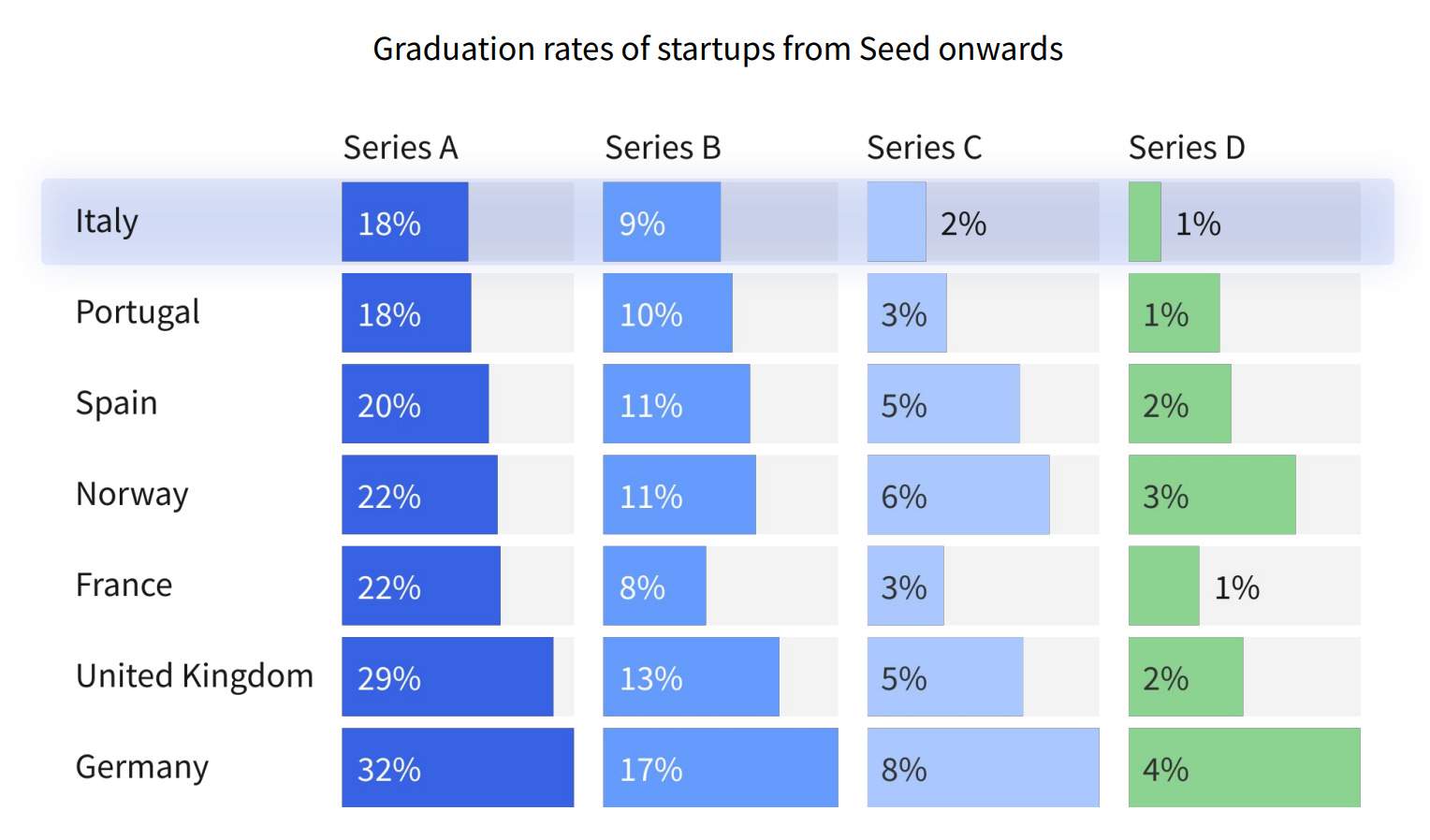
Among Italian companies that raised standardized seed rounds between 2015 and 2020, only 18% progressed to Series A, 9% to Series B, 2% to Series C and 1% to Series D. At Series A, that compares with 29% in the UK and 32% in Germany.
That financing gap helps explain the transition now taking place in Italy’s investment market: the emergence of multistage platforms that can support companies from seed through growth. During the panel session, speakers explored how Italy’s private capital ecosystem is entering a new phase of maturity. Funds are consolidating into multistage platforms spanning seed through growth, and capital is reaching new sectors beyond software.
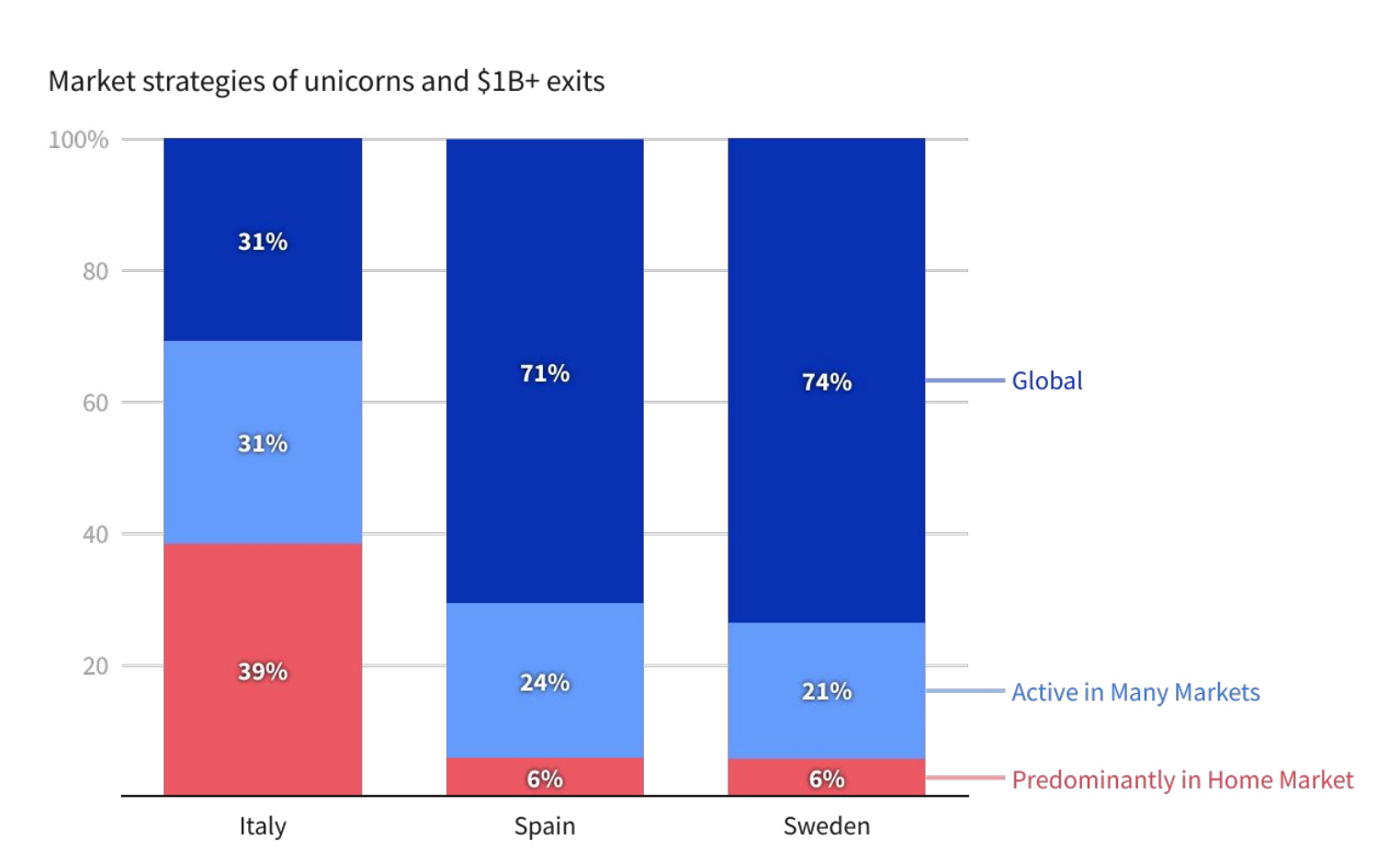
But more capital at later stages solves only part of the equation. Internationalization is the other. Italy’s most successful startups remain considerably more domestically focused than their peers. Dealroom finds that only 31% of Italian unicorns and $1bn+ exits pursue a primarily global market strategy, compared with 71% in Spain and 74% in Sweden.
The talent base reflects a similar challenge: only around 7% of founders at Italian startups have an international background, versus 19% in Spain.
Exein offers a useful example of what can happen when those pieces come together. The Rome-based cybersecurity company, founded in 2018, raised $270 million at a $1.7 billion valuation, becoming one of Europe’s most valuable private cybersecurity companies.
Just nine months earlier, Exein had been valued at roughly $770 million. Headline led its latest round, with participation from Sofina, Goldman Sachs, the EIB Group, KfW Capital and T.Capital, alongside existing international investors.
United Ventures was Exein’s first investor, backing the company with €2 million in 2018, when embedded cybersecurity was still a relatively niche investment thesis. Exein followed with a €6 million Series A in 2021 and remained an investor through subsequent rounds. Eight years after that initial investment, Exein’s technology is now deployed across more than two billion devices globally, while the company employs around 100 people and plans to double its workforce over the next 18 months.
This also illustrates what Giulia Giovannini, Partner at United Ventures, described as the ecosystem’s “multiplier effect.” Successful companies do more than create returns for their investors: they create wealth, develop experienced managers and technical talent, and produce founders and investors who can eventually recycle that experience and capital into the next generation of companies.
That multiplier effect ultimately raises a broader question: what kind of innovation ecosystem does Italy want to build as more companies reach scale? For Francesco Cerrutti, Managing Director of Italian Tech Alliance, the opportunity is not simply to catch up with Europe’s established tech hubs, but to build something distinctively Italian:
“When we talk about innovation in Italy, we should not think that our goal is simply to imitate the great international champions or constantly ask what other countries are doing better than us.
Instead, we should build our own path. Italy should create an innovation ecosystem with its own identity, credibility, and international prestige, one that attracts major global players and investors because they want to be part of what is happening here.
In other words, rather than always going abroad to ask others to invest in us, we should create an ecosystem strong enough that they come to us.
I believe this is exactly the direction in which the Italian innovation system should continue to move.”
But building a stronger scaleup ecosystem is not only a question of capital or international ambition.
The institutional environment needs to mature alongside the companies and investors operating within it. As Francesco Cerrutti, Managing Director of Italian Tech Alliance, says:
“Public policy has been the Achilles’ heel of the Italian ecosystem up to this point.
The ecosystem has seen successful companies, interesting exits, and IPOs, and has matured and become international.
But when it comes to policy, we are still essentially standing still.
And this matters enormously, because institutions are a fundamental pillar of a functioning innovation ecosystem.
More and more successful startups, founders, and capital are entering the ecosystem. But we need to make sure that all of this also translates into broader social and economic recognition, as well as greater engagement from institutions.”
There is still plenty of room for that cycle to deepen. The OECD notes that Italian venture capital investment increased fivefold between 2011 and 2023, but Italy still accounted for only around 4% of total EU VC investment, with VC funding to SMEs equal to 0.02% of GDP in 2024, versus 0.09% in France.
Join Us at 0100 International 2026!
These conversations will continue at 0100 International 2026, taking place October 28–29 at Palazzo Castiglioni in Milan. Organized by Zero One Hundred Conferences in partnership with the City of Milan, and building on the collaboration with Milano & Partners, the conference brings the international private markets community to the heart of Italy’s financial and innovation ecosystem.
To get a sense of what that looks like, take a look back at some of the highlights from 0100 International 2025.
This year, the event is limited to 700 decision-makers, including 550+ LPs and GPs, 120+ speakers and participants from more than 50 nationalities. More than 80% of attendees are expected to be Partners, CXOs, or Directors, with a balanced LP-to-GP ratio designed to bring together institutional investors, private wealth, fund managers, and other senior private capital professionals.
We look forward to seeing you in Milan.