


Hello there!
This week, we’re taking a closer look at family offices and how they're changing the way they choose fund managers.
Family offices are moving capital faster than UBS has ever recorded, but they’re also becoming more selective about where that money goes.
For years, the approach to private markets was pretty straightforward: invest more, work with more managers, and diversify. Today, family offices are starting to narrow things down.
They still believe in private markets, but they’re putting more capital with fewer managers. They want to see money actually returned to investors, not just strong valuations on paper. And they’re becoming more thoughtful and structured about how they choose GPs.
What is changing inside family office portfolios?
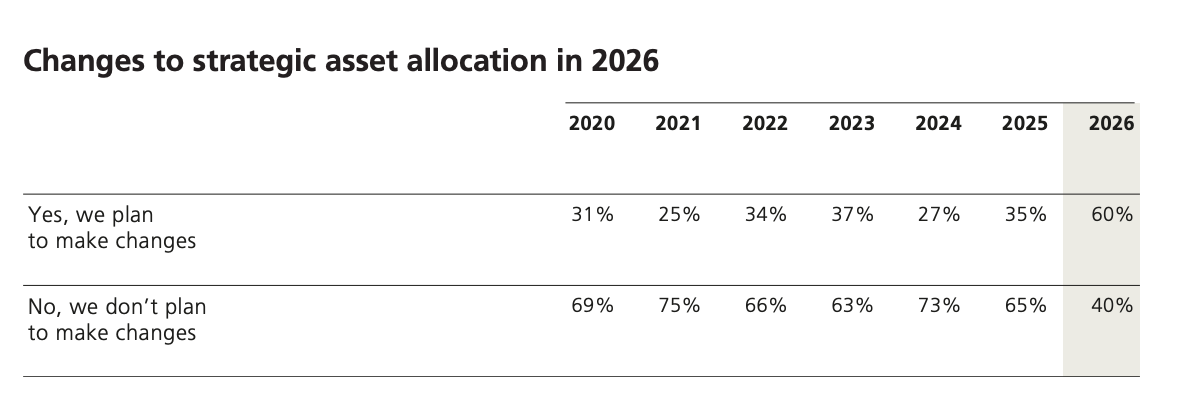
In UBS’s 2026 Global Family Office Report, 60% of family offices said they plan to change their strategic asset allocation over the next 12 months. That’s the highest level UBS has ever recorded, and a big jump from just 35% the year before.
The report surveyed 307 family offices across more than 30 countries, with each family managing an average of $2.7 billion in wealth and about $1.3 billion through their family office.
UBS describes it as a deliberate move to spread investments more widely across different asset classes, currencies, and regions. So, what’s driving all this change? There are a few factors influencing it at the same time.
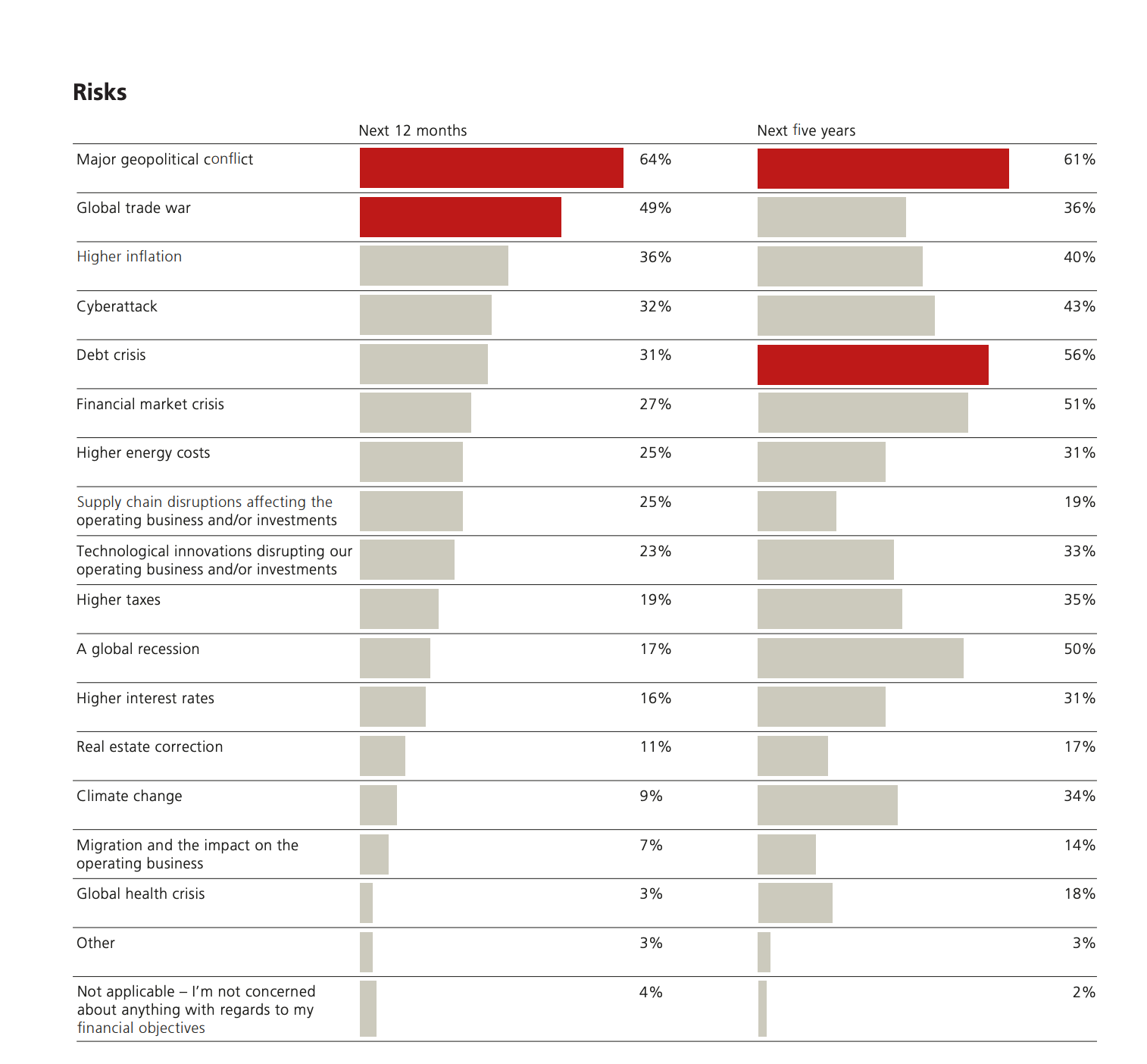
Geopolitical risk is a major concern. 64% of family offices named major geopolitical conflict as their biggest worry over the next 12 months. And 61% still see it as a major concern over the next five years.
In other words, they don’t see this as a short-term problem. Trade war concerns have eased somewhat, but worries about debt and recession become more important when family offices look further ahead.
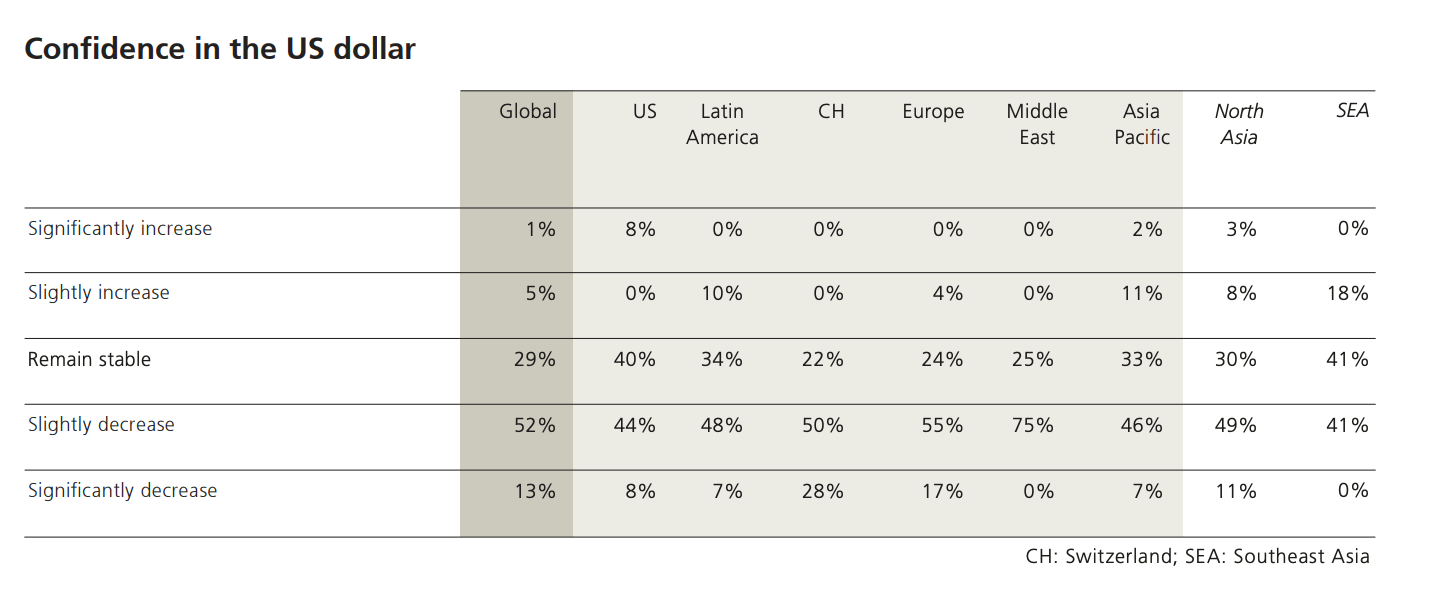
Confidence in the American dollar is weaker. 65% expect confidence in the US dollar as the world’s reserve currency to weaken over the next year, while only 6% think it will improve.
The dollar is also the only major currency where a large number of family offices- 47%- say they have too much exposure. As a result, 29% have already reduced their dollar holdings or are considering it.
But this looks very different depending on where the family office is based. US family offices are actually investing more at home, with their domestic allocation rising from 86% in 2025 to 88% in 2026. European and Asian family offices, meanwhile, are looking more actively at other regions, including Asia Pacific, Greater China, and Western Europe.
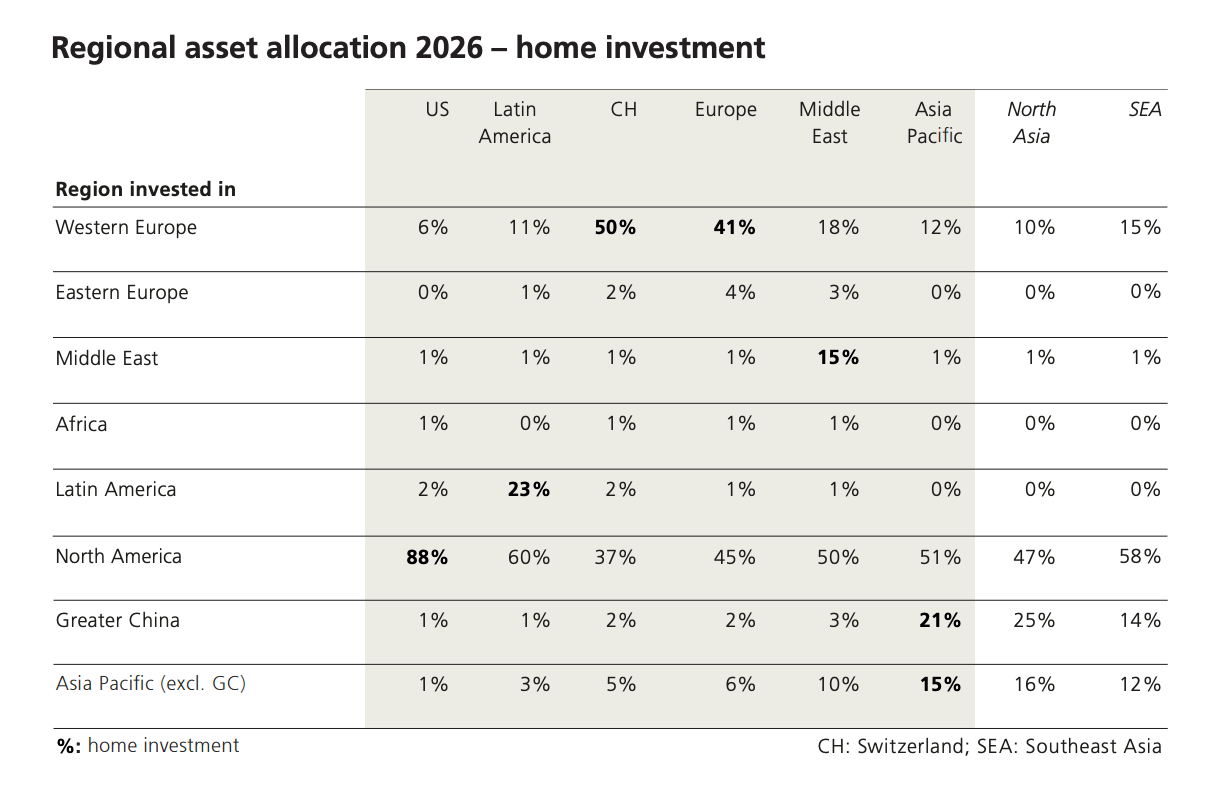
North America still represents the largest share of global allocations at 52%, so this isn’t a rush away from the region. It’s more of a gradual rebalancing.
Real estate is becoming less attractive, while other areas are gaining attention. Among family offices planning portfolio changes, real estate allocations are expected to fall from 11% in 2025 to 8% in 2026. At the same time, more money is expected to move toward areas such as emerging market equities and infrastructure.
Then there’s the huge generational wealth transfer ahead.
Estimates suggest that somewhere between $84 trillion through 2045 and roughly $124 trillion through 2048 could pass from one generation to the next.
High- and ultra-high-net-worth households make up just 1.5% of all households, but they are expected to account for 42% of that wealth transfer. That could also lead to the creation of many new family offices, often led by a new generation that may not feel tied to the same fund managers or investment relationships their parents used.
But there’s another problem: many family offices aren’t fully prepared for that transition. Only 35% have a succession plan for the family office itself, and just 27% have a formal process for preparing the next generation to take over.
So, trillions of dollars are expected to change hands while many of the organizations managing that wealth still haven’t fully planned for their own leadership transition. That adds another layer of uncertainty, and another reason to rethink where and with whom they invest.
From IRR to DPI. How to build conviction today?
McKinsey’s 2026 Global Private Markets Report, based on a survey of 300 of the world’s largest LPs, found that DPI is now tied with MOIC as the second most important metric investors use when deciding where to put their money. DPI, distributions to paid-in capital, simply measures how much cash a fund has returned to investors compared with how much they invested.
54% of LPs now describe DPI as “critical” or “most critical” when making investment decisions. IRR still ranks first, but its lead isn’t as strong as it once was.
Cash isn’t coming back as quickly as it used to.
Last year, distributions as a share of AUM had fallen to roughly 6%, compared with a 10-year average of 14%. That’s well below the 10-year average of about 14%, and even further below the roughly 16% seen earlier in the previous decade.
Five-year rolling DPI is also at its lowest recorded level.
At the same time, funds are holding investments for longer. In infrastructure, for example, the average age of investments that hadn’t yet been exited increased from around 3.1–3.3 years between 2017 and 2022 to roughly 3.5–3.8 years in 2023–2024.
Even the strongest funds have seen returns come down somewhat. Top-quartile buyout funds raised between 2010 and 2014 produced average IRRs of around 25%. For funds raised between 2018 and 2022, that figure fell to roughly 23%.
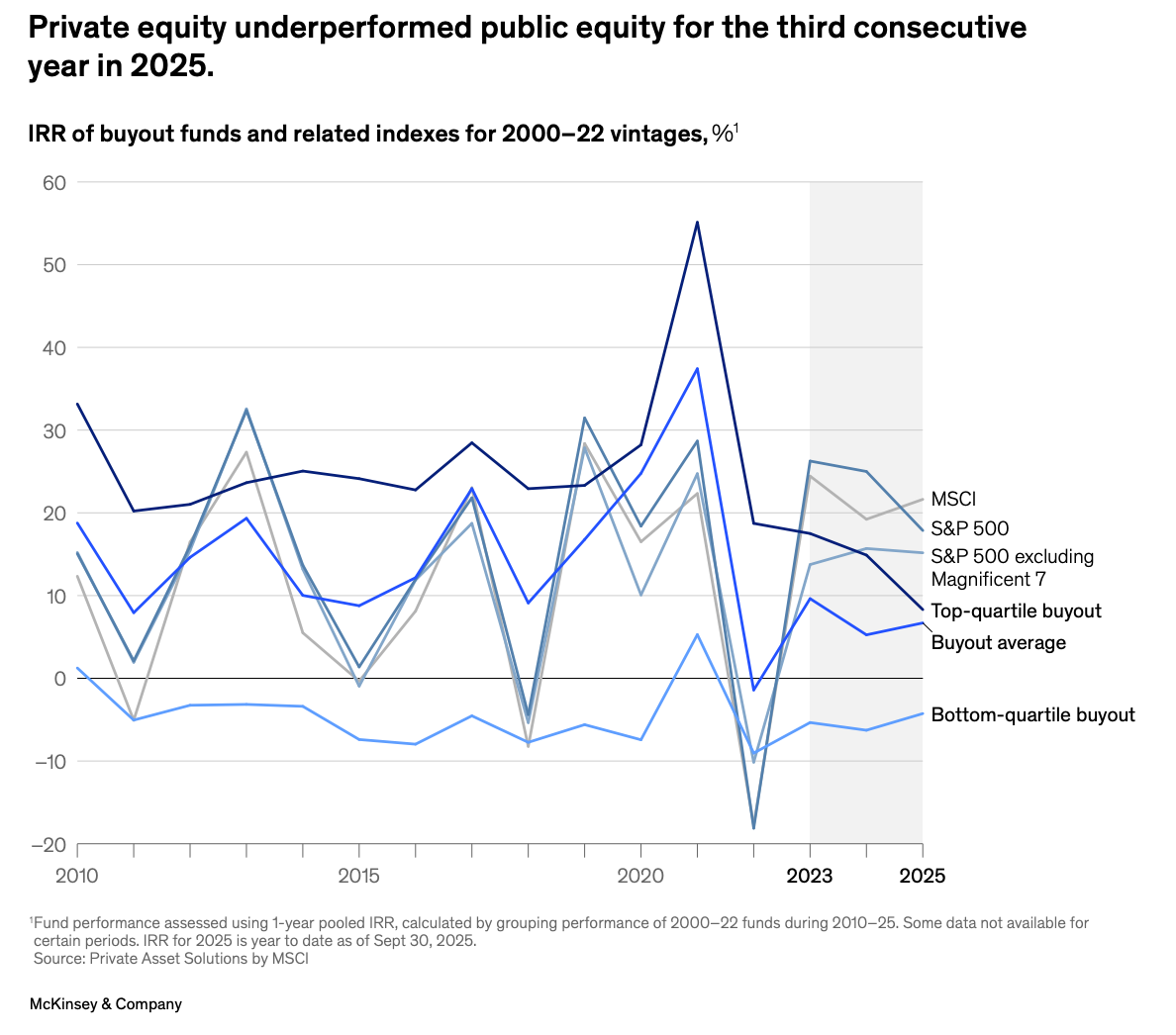
LPs are less willing to rely on strong returns on paper when it’s taking longer to turn those returns into actual cash. You can see that clearly in what investors say they’re worried about. In McKinsey’s survey, 70% of LPs named delayed exits and a lack of liquidity as a top concern. Another 62% pointed to the risk of valuation write-downs. Both ranked above most other concerns.
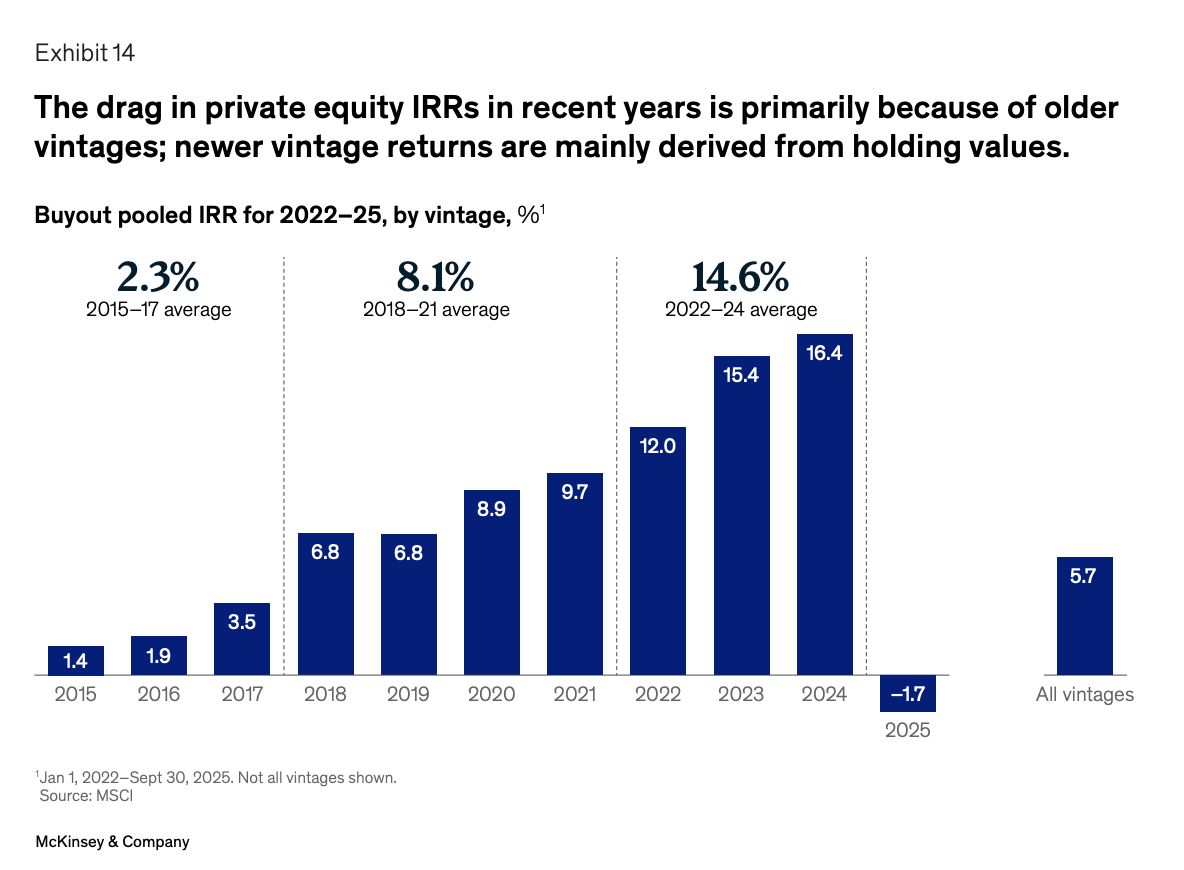
That’s leading LPs to concentrate their capital with fewer managers.
When investors are less confident in projected returns, they naturally favor managers who have already shown they can return real money.
Preqin data cited by Moonfare shows that around 70% of LP commitments in 2024–2025 went to GPs they had invested with before. Five years earlier, that figure was around 60%.
That leaves a relatively small part of the market open to new relationships. In practical terms, only around $10–15 out of every $100 committed may realistically be available to a manager who doesn’t already have a track record with that LP.
At the same time, Allianz Trade estimates that LPs have reduced the total number of GP relationships they maintain by around 20–30% on average. So LPs work with fewer managers, but often put more money behind the ones they trust.
The framework family offices actually use
Family offices typically evaluate prospective GPs across five dimensions: track record and return attribution (net IRR, TVPI, and DPI across prior funds), clarity of investment thesis and market opportunity, fund terms and alignment, operational infrastructure and compliance readiness, and team stability with a documented succession plan.
Two of these areas have become much more important for LPs.
First, GPs need to have their own money invested in the fund. This shows LPs that the manager has real skin in the game. For first-time funds, the median GP commitment has risen to 3% of the total fund size, compared with 1.5% a few years ago.
Second, LPs want to know what happens when key people leave or step back. Succession planning has become a major part of due diligence. A February 2026 Harvard Law analysis found that 96% of LPs consider succession planning important when deciding whether to invest with a manager again, while 74% say team stability is the most important qualitative factor they look at. For emerging managers, 62% of allocations also depend on the founding GP staying actively involved.
Co-investment access is also becoming an expectation. What once helped a GP stand out is seen as standard. LPs want the option to invest directly alongside a fund, giving them more flexibility and greater control over how their capital is deployed.
Let’s Continue the Conversation at 0100 Emerging Europe!
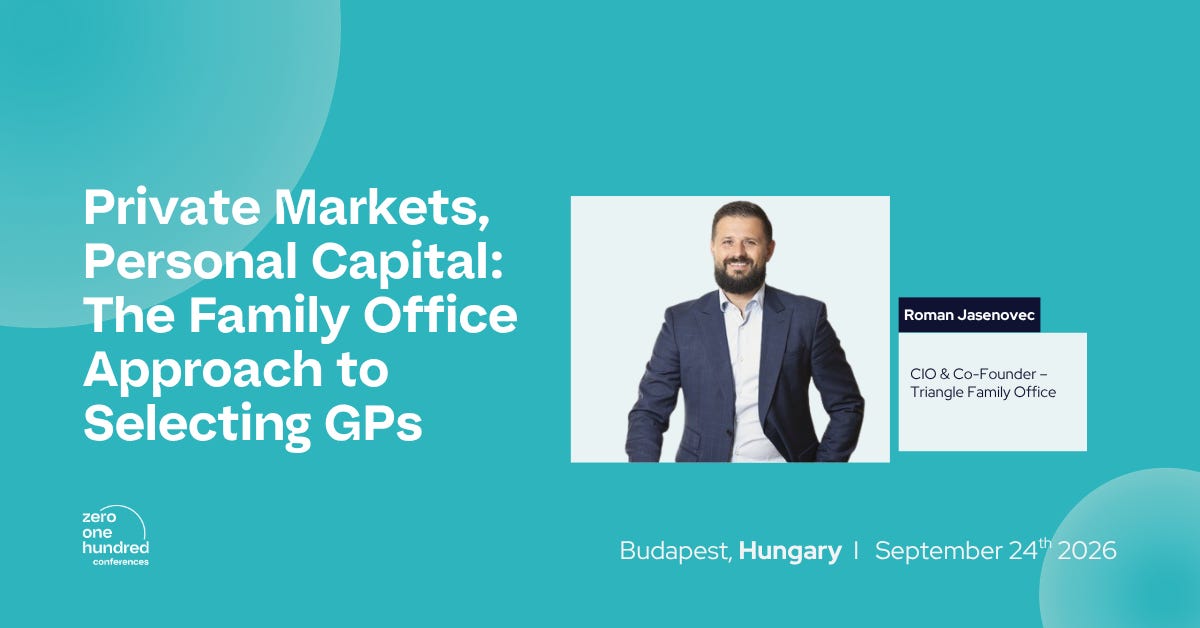
We’ll explore these questions in our upcoming session at 0100 Emerging Europe. Roman Jasenovec, Co-Founder and Chief Investment Officer at Triangle Family Office, will share how family offices select managers across private equity, venture capital, and other alternative strategies.
The conversation will look at how family offices build conviction in a GP, what turns an investment into a long-term partnership, and how they evaluate alignment, discipline, and performance potential.
Interesting angle. I like the focus on how family offices actually select managers rather than just looking at headline fund performance.
The alignment and decision process behind choosing a GP is probably just as important as the asset class itself.
Would be good to connect.
What I've noticed is family offices don't really diligence GPs, they diligence whether they'd be embarrassed explaining the manager to the next generation at a kitchen table. That filter is not in any DDQ and it kills more allocations than track record does.