


Hello there!
Public-market volatility in emerging Europe has been the headline story of 2026. But underneath the index moves is a venture ecosystem that’s re-rating fast: capital is flowing into CEE defense and deep tech at record pace, a historic election just flipped the region’s most contrarian government pro-EU overnight, and local exchanges are pulling in the kind of turnover that signals real liquidity is finally arriving for later-stage exits.
For VCs underweighting the region, the entry points are getting harder to justify skipping.
The Macro Backdrop: Why Volatility is The Opportunity, Not The Risk
Emerging Europe in 2026 is characterized by a split screen. Currency and rate volatility remain real; Turkey is still running inflation near 32% and a policy rate of 37%, while the lira continues its "managed devaluation," recently hitting record lows past 47 per dollar.
Yet the CEE core (Poland, Czechia, Romania) is posting some of the strongest, most liquid returns in any public market globally. The Warsaw Stock Exchange saw record turnover in January 2026, with share turnover up 99% year-on-year and ETF trading up over 300%, alongside all-time highs across its main indices, a strong proxy for improving institutional risk appetite in the region generally, which typically precedes an uptick in growth-stage venture liquidity and cross-border LP interest.
This combination - pockets of acute volatility (Turkey, geopolitics) sitting next to structurally improving fundamentals (Poland, Romania, post-election Hungary) is exactly the setup where mispricing tends to show up first in private markets, before public multiples catch up.
For VCs, the region might reward investors who can underwrite country-specific and currency risk explicitly rather than trading it away. Funds with local presence or LP relationships in-market are picking up better terms right now precisely because generalist Western European and US capital is still under-allocated here.
A New Catalyst: Hungary’s Political Reset
On April 12, 2026, Viktor Orbán’s 16-year rule ended in a landslide. Péter Magyar’s Tisza party won 138 of 199 seats, a two-thirds constitutional majority, on record turnout.
Markets moved immediately: the forint jumped to a four-year high and 10-year bond yields fell as much as 50 basis points the following morning. The result is expected to unlock roughly €17 billion in EU grants plus low-interest defense loans that had been frozen under the prior government, and to end years of Hungary acting as a blocker on EU-Ukraine funding decisions.
Frozen EU cohesion and recovery funds have been a real drag on Hungarian founders’ access to grant-matched capital and government co-investment vehicles; a pro-EU government re-engaging with Brussels plausibly reopens that pipeline. Hungary’s startup scene, smaller than Poland’s or Romania’s but supported by local and government-backed early-stage capital, is one to watch for a re-rating over the next 12-18 months as political risk premium comes out of the market.
Country-level Signal For Venture Allocators
Poland — the region’s outperformer according to VanEck’s on-the-ground CEE survey, benefiting from EU funding inflows, elevated defense spending, and the deepest, most liquid capital markets in CEE (WIG hit successive all-time highs through Q1 2026, with the broader index up nearly 47% year-on-year).
Largest VC market in the region;
Strongest activity in fintech, marketplaces, and enterprise software 18,
A growing deeptech and space tech cluster;
Romania — the decade’s best-performing equity market in the region (BET-TR index +758% over 10 years in euro terms, +32% year-to-date in 2026), reflecting broader structural investor confidence that is translating into venture terms too. Known for capital-efficient, engineering-heavy founding teams; now an explicit target market for new defense/dual-use growth capital (E2D fund) and general early-stage vehicles (Nucleo Ventures).
Hungary — post-election re-rating story. Forint at a four-year high 5, EU funding pipeline reopening 6, government-backed early-stage capital already active. Political risk premium likely compresses through 2026-27, which historically pulls in generalist capital that had stayed away.
Czech Republic — quieter but consistent: +53.4% equity performance in 2025 was the region’s best, and the startup scene is known for technical, product-focused founders with growing seed and early-stage capital availability.
Turkey — the highest-volatility, highest-optionality market in the set. BIST 100 is up nearly 40% year-on-year even as the lira sets fresh record lows and inflation sits near 32%, underscoring that local-currency equity and venture returns can look strong in nominal terms while FX risk erodes USD/EUR-denominated returns. Underwrite currency separately from operating business quality here; the spread between the two is unusually wide right now.
Greece — smaller, more overlooked entry point (Athens Stock Exchange market cap ~€101.5 billion), with early deep tech names (e.g., AI-driven drug repurposing, post-quantum cryptography startups) emerging from Genesis Ventures- and Marathon Venture Capital-backed cohorts. Worth a look for funds seeking less-crowded deal flow.
What to watch next
Hungary’s EU re-engagement timeline — how quickly frozen grants and defense loans actually flow will be a leading indicator for when generalist capital re-enters Hungarian venture.
ETCI 2’s rollout — €80 billion in prospective scale-up capital, if deployed as planned, could finally close Europe’s Series C+ gap that has historically forced CEE’s best companies to seek US growth capital or exit early.
Defense-tech consolidation — M&A in the sector already hit an all-time high in 2025 (4x the level of four years ago) with zero IPOs; expect exits in 2026-27 to keep coming via strategic acquisition rather than public listings, which has implications for fund-return timelines and DPI.
Turkish disinflation path — the CBT’s own end-2026 inflation projection moved from a 15-21% range up to 26% earlier this year amid energy-driven shocks tied to the Middle East conflict 24; a faster-than-expected resolution there would be a real catalyst for Turkish venture and growth-equity revaluation.
Let’s continue the conversation!
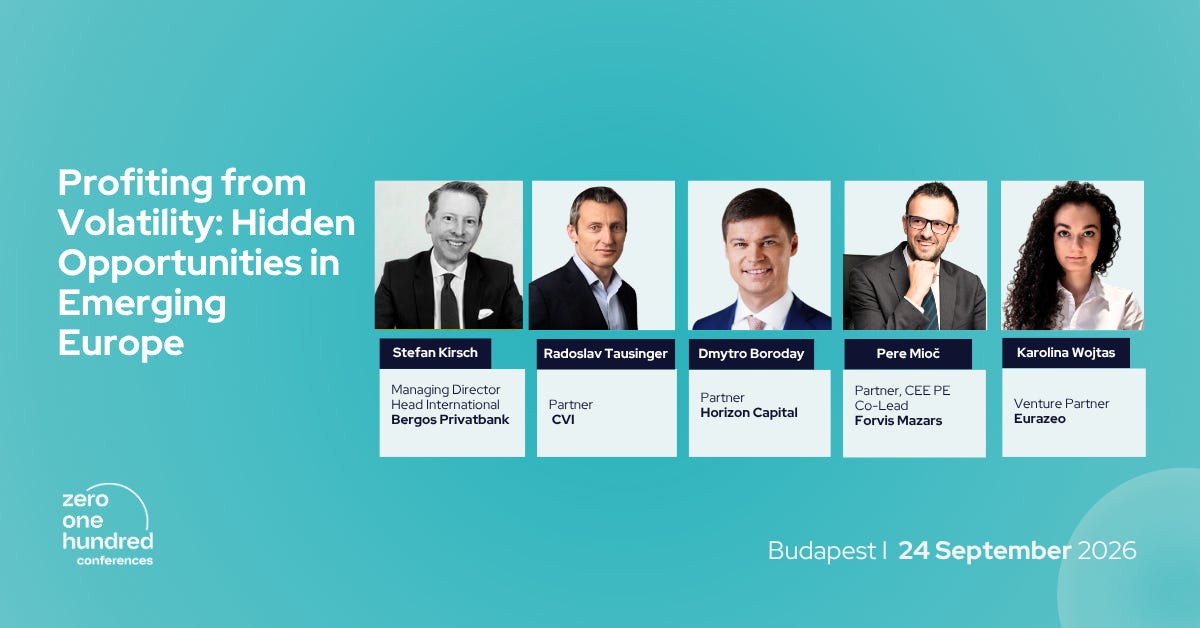
If this discussion sparked more questions than it answered, that's exactly the point, and there's more where it came from.
Join us at 0100 Emerging Europe, taking place 23–24 September 2026 in Budapest, where the region's LPs, GPs, and founders will pick up this exact conversation in person. With Hungary's political and economic reset as a live backdrop, there's no better place or moment to get a read on where CEE capital is heading next.
We have a panel discussing this topic and bringing together LPs and GPs to dig into where the region's risk is being mispriced and where value creation is actually happening. Stefan Kirsch (Bergos Privatbank), Radoslav Tausinger (CVI), Dmytro Boroday (Horizon Capital), and Karolina Wojtas (Eurazeo Ventures) traded perspectives on private debt, growth equity, and deeptech across Czechia, Slovakia, Hungary, the Baltics, and Ukraine, moderated by Pere Mioč (Forvis Mazars)