


Hello there!
This week, we’re tracking how Europe’s strategic autonomy agenda is reshaping the investment map.
For years, CEE sat on the periphery of Europe’s growth story. It has long had the talent, but not the same share of institutional attention. Western Europe attracted the larger funds and bigger rounds, while the region was often framed as a lower-cost alternative.
Now, the strategic case is catching up with the talent story. Defense, energy security, resilient supply chains, and reduced dependence on external powers are all pushing CEE closer to the center of Europe’s economic and investment agenda.
Why has resilience become the agenda?
The scale of the problem Europe is trying to solve is worth restating. Mario Draghi’s September 2024 competitiveness report put the EU’s additional investment need at roughly €800bn a year, about 5% of EU GDP, a share not seen in Europe since the Marshall Plan, to close three gaps at once: innovation, decarbonization, and security.
Mario Draghi found that 30% of EU-born unicorns founded since 2008 have relocated to the US, that European industrial energy prices run up to five times higher than in the US, and that Europe’s dependence on China for critical raw materials and on the US for advanced technology leaves it exposed on both flanks at once. Of the €800bn total, Draghi costed the energy transition alone at €300bn in energy investment plus €150bn in transport, leaving the remainder split across innovation and defense-related security spending.
That last pillar has since become the most concrete. The EU's ReArm Europe / Readiness 2030 plan aims to unlock over €800bn in defense spending over the decade, built on three lines of action, including the Security Action for Europe (SAFE) instrument.
SAFE makes the capital transition toward CEE tangible. Poland led the first round with €43.7bn, followed by Romania at €16.7bn and Lithuania at €6.4bn. By offering long-term financing on favorable terms, the program disproportionately benefits countries facing higher standalone borrowing costs, while Germany, already able to finance defense cheaply and backed by its own €100bn fund, opted out.
It's now the organizing logic behind a growing stack of capital vehicles:
… and now SAFE's €150bn in defense loans, all built on the same premise: that Europe can't out-innovate its dependence on outside capital; it has to out-invest it. What's different about SAFE, specifically, is that, unlike venture-stage vehicles, the money is already visibly concentrating in CEE rather than debating whether it should.
Why is CEE becoming the anchor?
The regional data backs up why CEE keeps coming up in that conversation. In 2025, startups across Eastern Europe raised €3.6bn across 1,034 transactions, about 5.5% of total European venture capital, a resilient number given the broader global slowdown.
While deal activity declined, total capital remained broadly flat. So, fewer companies are raising, but average round sizes are getting bigger.
Poland is the best example. Its tech ecosystem reached a total value of €56.5bn in 2025, growing 2.8x since 2019, slightly ahead of the CEE average, and now accounts for 26% of total CEE enterprise value, roughly as large as the next two biggest CEE markets combined.
Greece and Bulgaria are following closely: Greek startups raised €732m across 95 deals in 2025, up 35% year over year, while Bulgaria posted 76 funded startups per million people since 2020—four times the Southeast Europe average.
Defense Tech and CEE’s investment map
Nowhere is the "resilience over cost" reframing more evident than in defense and dual-use. European defense tech funding now accounts for an estimated 6.2% of total European venture capital, up from less than 1% before 2020.
CEE investors surveyed for that same report were direct in saying why: proximity to the war in Ukraine has made defense tech a default allocation for the region.
Perhaps the clearest sign that Europe’s approach to defense tech has structurally changed is that Brussels can now become a shareholder. Through its new €100m STEP Defense Scale Up call, the EIC can invest up to €30m directly in defense companies while crowding in private capital for substantially larger rounds. It is the first direct-equity mandate for defense in any EU funding program.
Venture rounds tell only part of the story. The trends are also showing up in factories, production lines, and industrial capacity. CEE has attracted more than €4bn in announced nearshoring investment across recently tracked projects, representing over 6,600 planned jobs, with industrial and manufacturing projects accounting for much of that activity. BMW’s new Debrecen plant in Hungary and Mercedes-Benz’s operations in Jawor, Poland, are two clear examples.
The corporate pipeline points in the same direction. 55% of German companies surveyed intend to invest in CEE over the next five years, and 32% are planning commitments above €5m. Production is a major part of that story: 29% are targeting capacity expansion, while more than a quarter are considering shifting production from Germany into the region.
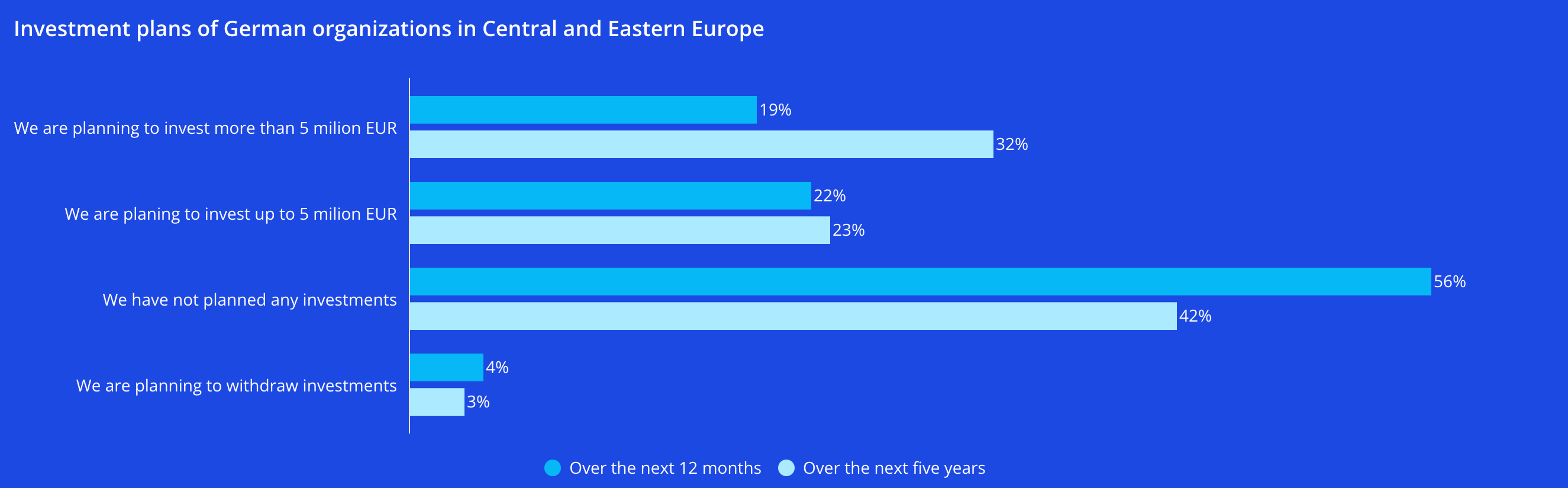
And the reindustrialization story overlaps with defense. German companies already see automotive, digital infrastructure, battery technology, and industrial production as core areas of CEE’s future manufacturing base.
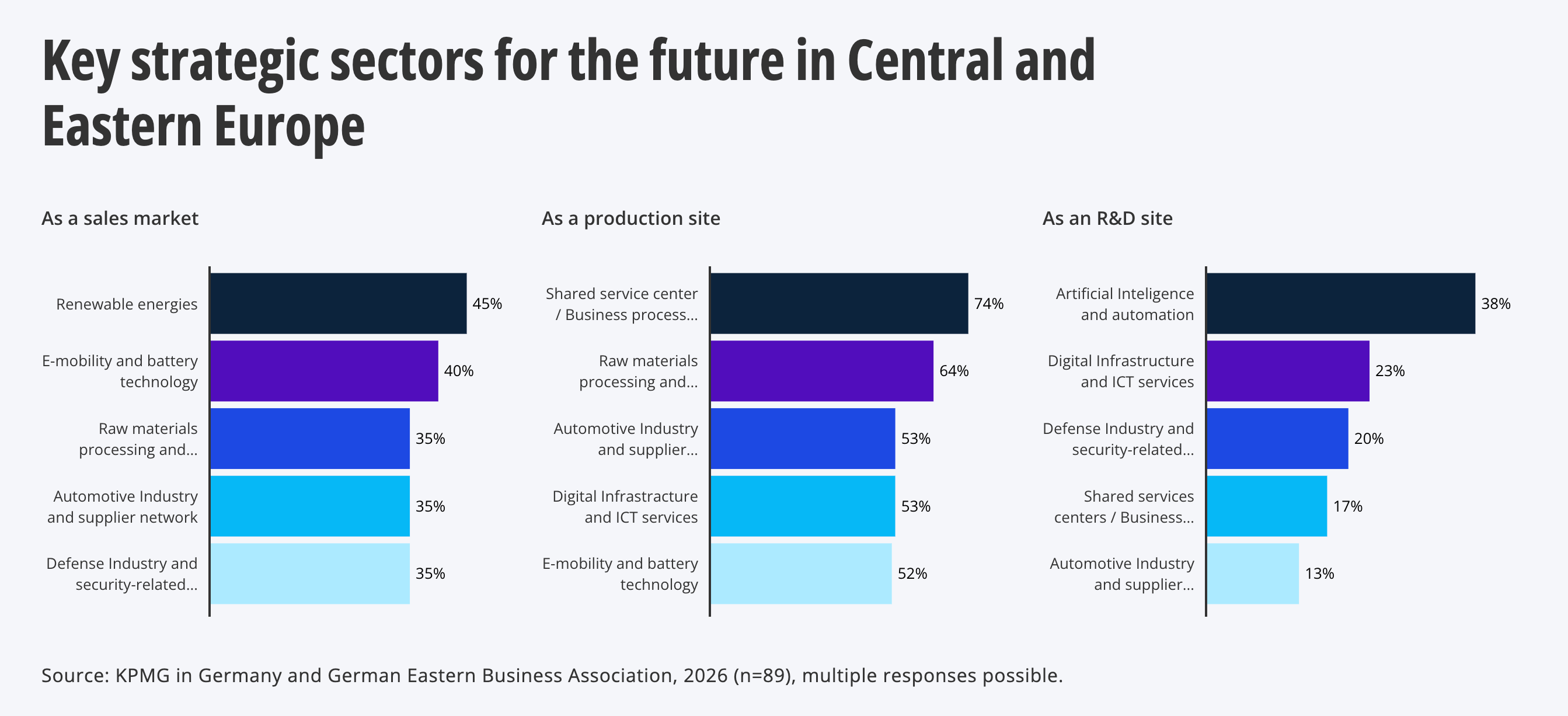
Defense and security now sit within that same strategic mix, with 35% identifying the sector as an important future market and 20% highlighting its potential as an R&D field, according to the same KPMG study.
That capacity is being pulled toward CEE specifically: across Europe, 86% of companies now rank supply-chain resilience above short-term profit as a driver of reindustrialization decisions, and the strongest reshoring activity is concentrated in the sectors CEE already competes in: automotive, electronics, and defense-adjacent manufacturing.
The biggest challenge: Europe still has a scale-up problem
There is one obvious constraint on the thesis: Europe still lacks the capital depth to finance its strategic ambitions at scale. EU-based VC funds manage roughly €150bn, versus around €930bn in the US. The problem is particularly acute at the growth stage, when companies move beyond €5m or €10m rounds and start needing €50m, €100m, or more.
That is precisely the point at which CEE’s strongest companies become most vulnerable to capital migration. Europe can fund the engineer, the prototype, and increasingly the first defense contract. It is still much less reliable at funding the factory, the production ramp, and the global expansion that comes next.
The new wave of EU sovereignty capital helps, but it also creates a second tension. If public capital consistently follows the companies already capable of attracting major institutional rounds, Europe risks subsidizing existing capital concentration rather than broadening the pool of strategic companies that can reach scale.
CEE complicates that picture in a useful way. Capital scarcity has historically forced the region to build differently. Companies operate with lower burn, engineering talent remains comparatively cost-efficient, and industrial expansion can often be achieved with less capital than in Western European markets.
That means the same €30m or €50m check can potentially buy more engineering capacity, more production, and more runway in CEE. In a market where Europe’s strategic ambitions are likely to remain larger than the capital available to finance them, capital efficiency stops being a regional disadvantage and starts becoming a strategic asset.
Let's Continue the Conversation at 0100 Emerging Europe!
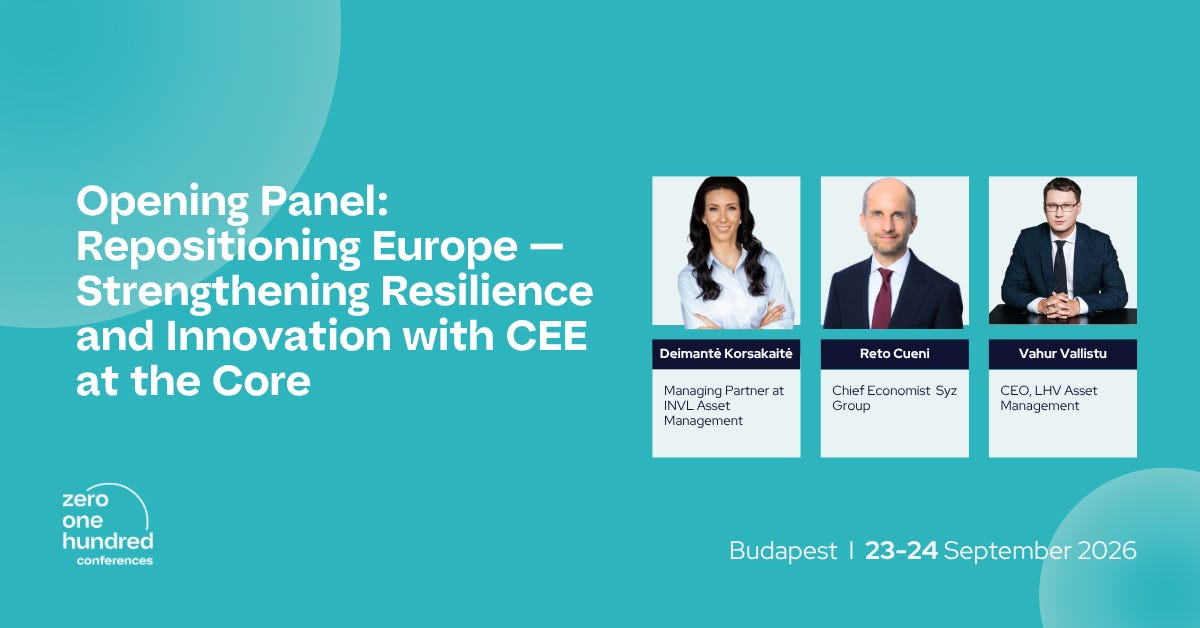
This is precisely the debate we'll be having on stage in Budapest later this month. Our opening panel brings together investors and operators to unpack how CEE is helping anchor a more robust, adaptable, innovation-driven European economy, and what it will actually take for the region to reinforce Europe's capacity to act independently on the global stage.
Joining the discussion are Deimantė Korsakaitė of INVL Asset Management, Jeremy Brown of Anthemis, Vahur Vallistu of LHV Asset Management, and Reto Cueni of Syz Group — bringing perspectives across private equity, venture, institutional capital, and macroeconomics.