


Hello there!
This week, we’re looking at how secondaries are moving from the margins of private equity to the center of how the industry manages liquidity.
Traditional exits remain difficult, LPs want cash back, and GPs do not necessarily want to sell their strongest companies into an unfavorable market. Continuation vehicles offer a compromise: liquidity today for some investors, longer ownership for others.
That makes them useful. It also makes them complicated. As GP-led deals become more common, pricing, conflicts, and the quality of the assets being rolled forward matter more than ever.
The Liquidity Problem Secondaries Are Solving
For most of private equity’s history, the model was straightforward: raise a fund, buy companies, improve them, exit through M&A or an IPO, return capital and raise again.
That model depends on a functioning exit market. Over the past several years, the problem hasn’t been a lack of reported value; it’s been converting that value into cash.
The average global PE holding period reached a record 6.6 years in 2025, versus 6.1 years between 2011 and 2020. More than 16,000 buyout-backed companies had been held for over four years, representing 52% of global buyout inventory and the highest share on record.
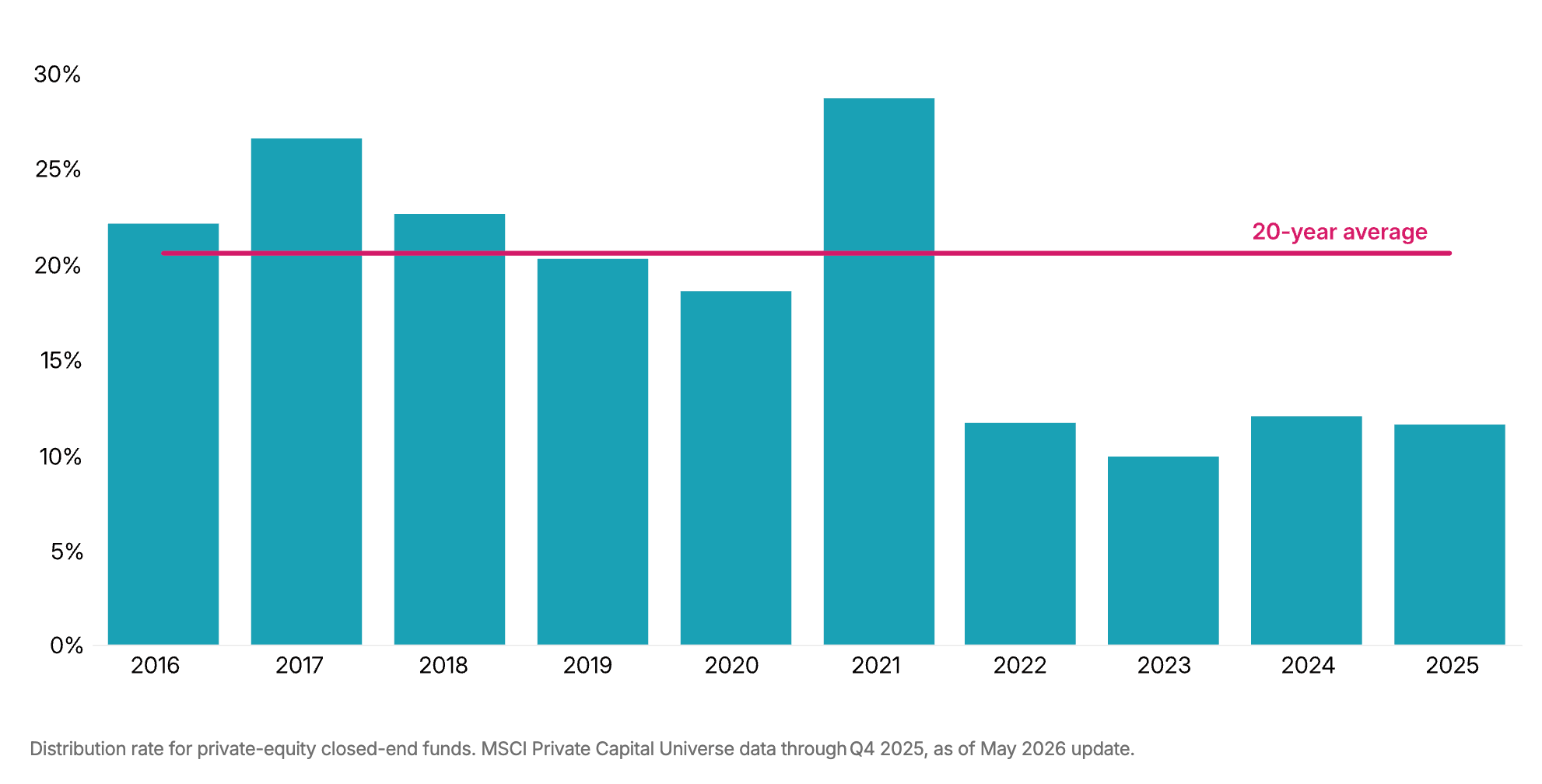
The pressure is particularly visible in distributions. Private-equity closed-end funds returned only 12% of asset value to investors in 2025, just over half the 20-year average, according to MSCI. Distribution rates have now remained near decade lows for four consecutive years.
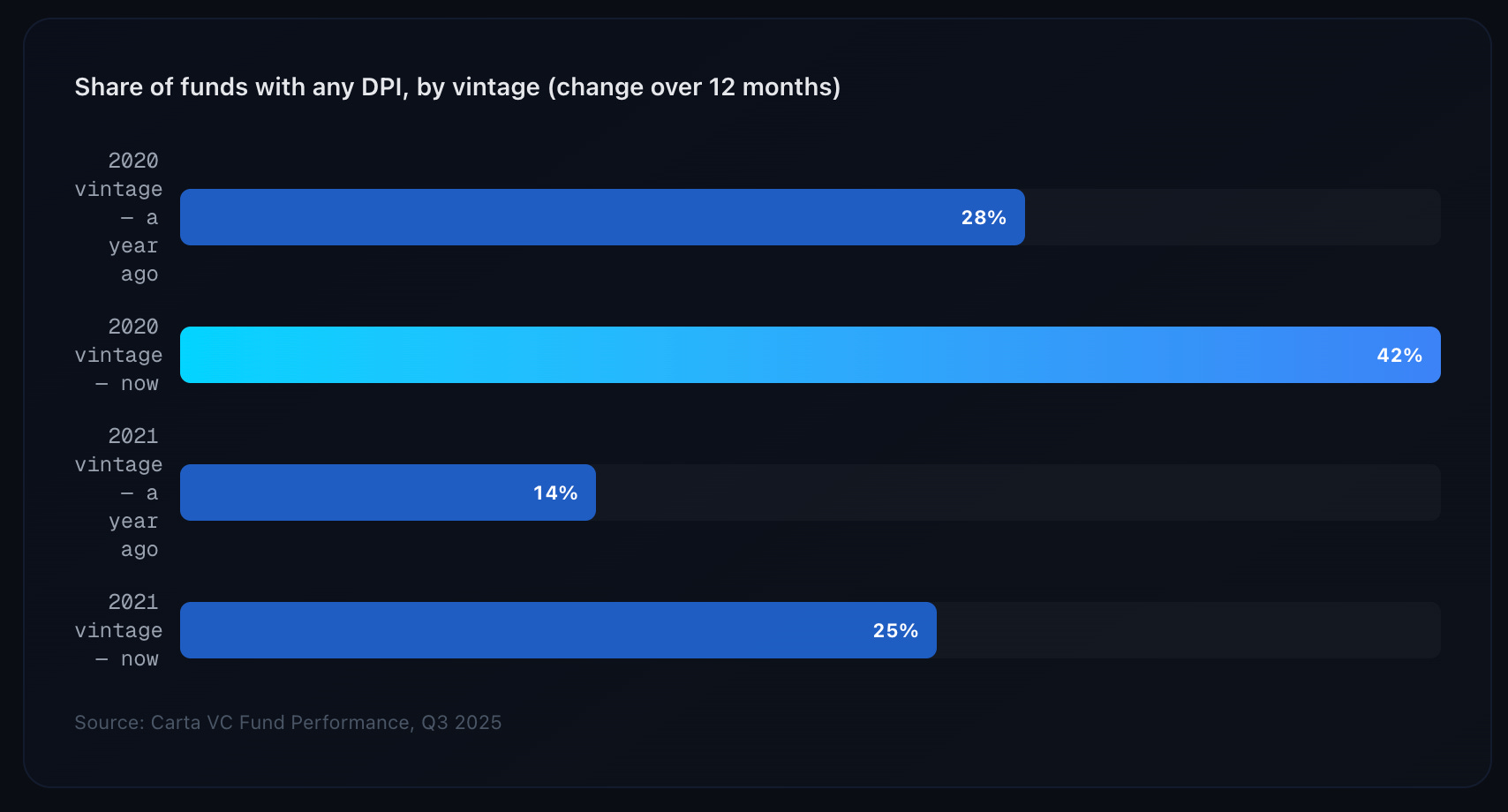
Venture offers an even more extreme example. Carta data show that, through Q3 2025, only 25% of 2021-vintage venture funds had generated any DPI. Subsequent analysis of the cohort estimates aggregate DPI at roughly 0.08x—about $8 returned for every $100 invested five years into the fund’s life.
There are signs of recovery, but the headline numbers inflate the breadth of it. Global buyout deal value rose 44% to roughly $905bn in 2025, while exits increased 47% to about $717bn. Yet distributions remained historically weak, highlighting the gap between renewed transaction activity and cash returning to LPs.
The recovery has also been concentrated at the top end. Allianz estimates that mega exits represented roughly 78% of 2025 exit value, leaving much of the mid-market inventory effectively stuck. In other words, liquidity has returned faster for large, high-quality assets than for the broader portfolio of PE-owned companies.
Even when transactions happen, they are taking longer. Longer execution periods add another drag to a system already struggling to turn portfolio marks into distributions. That liquidity shortage is increasingly feeding directly into fundraising.
LPs are placing greater weight on DPI rather than paper returns, and PwC mentions that managers coming back to market without credible distributions now face an “existential fundraising challenge.”
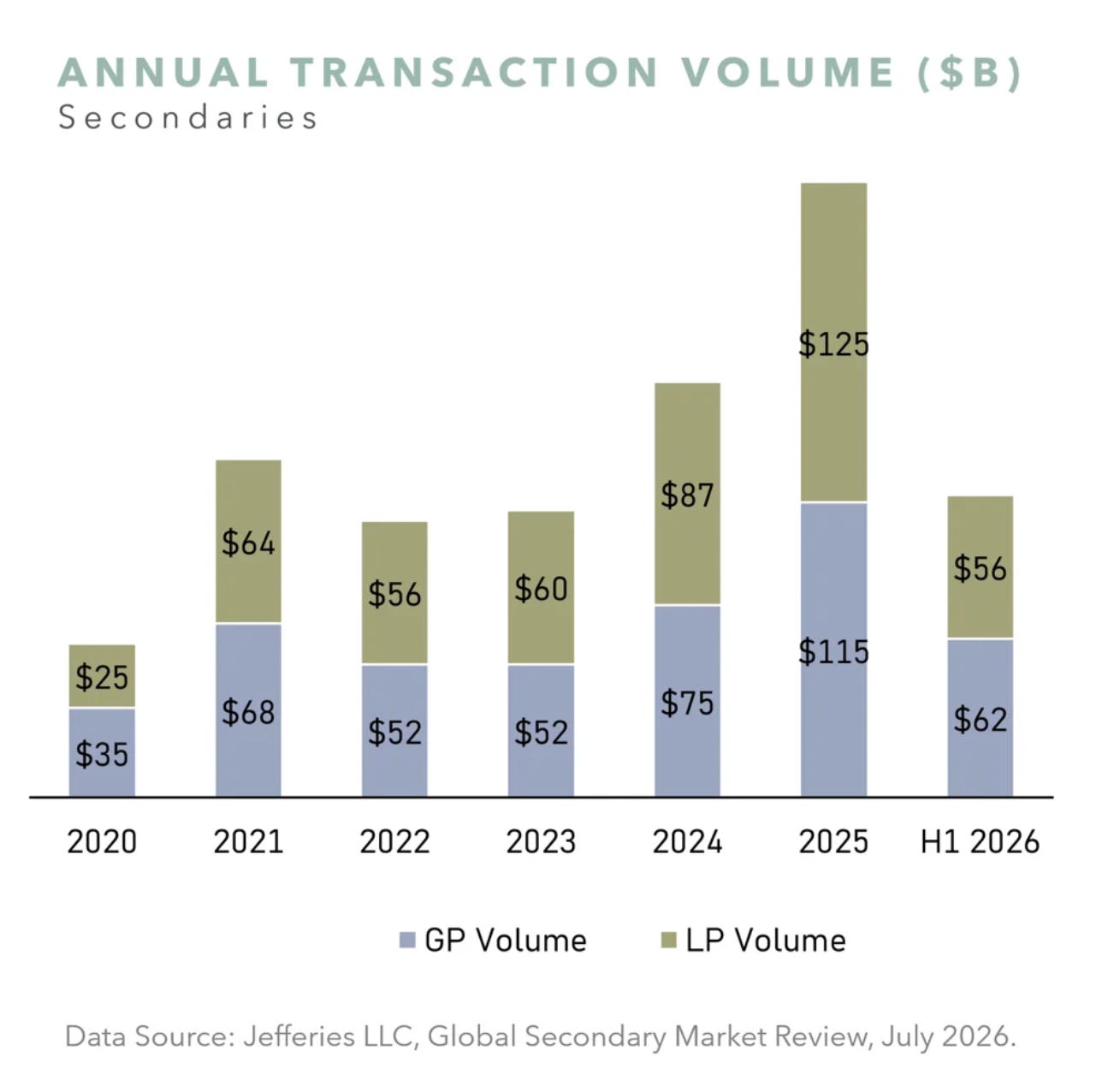
This is the environment in which secondaries have moved from a portfolio-management tool to a central part of private equity’s liquidity infrastructure. Global secondary transaction volume reached a record $118bn in H1 2026, up 15% year on year, with GP-led transactions accounting for 53% of activity.
Continuation Vehicles Are Becoming a Fourth Exit Route
The clearest expression of private equity’s changing liquidity model is the continuation vehicle. Instead of selling a portfolio company to a strategic buyer, another sponsor, or the public markets, a GP transfers the asset into a newly created fund that it continues to manage.
Existing LPs can take cash or roll their exposure into the new vehicle, while secondary investors provide the capital needed to finance the transaction. Continuation-vehicle exits represented 14% of global sponsor-backed exit volume in H1 2026. Adoption among the largest managers is already widespread: 82 of the world’s 100 largest sponsors by AUM have completed at least one continuation vehicle.
That puts CVs alongside the three conventional PE exit routes:
strategic M&A
sponsor-to-sponsor sales
IPOs.
A traditional exit transfers both ownership and control. A continuation vehicle can generate a realization for the old fund while allowing the same GP to retain control and reset the ownership clock for several more years.
The fastest-growing part of the market is the single-asset continuation vehicle, typically built around a company the GP considers one of its strongest holdings. Single-asset CV volume reached $34bn in H1 2026, up 88% year on year and accounting for 53% of GP-led secondary volume, according to Evercore.
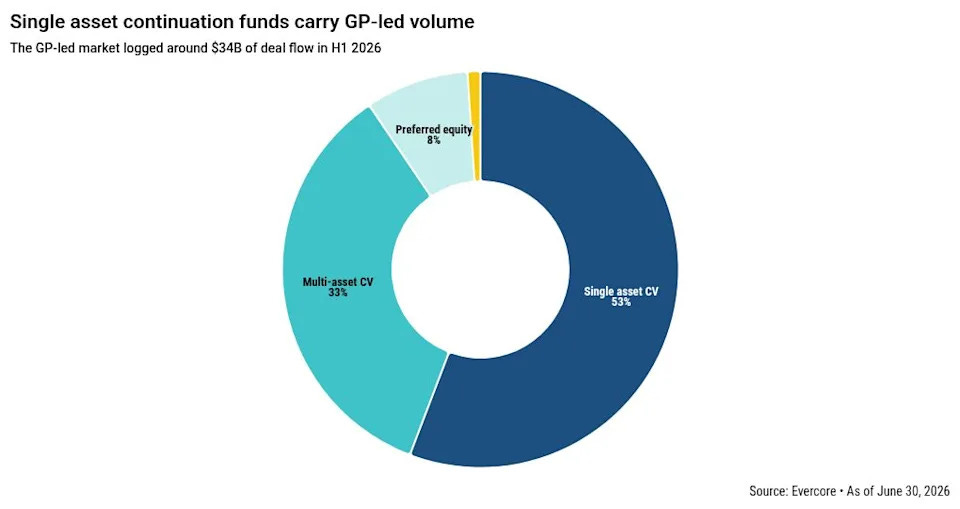
Pricing suggests these are being underwritten as high-quality assets rather than repositories for companies a GP cannot sell. In H1 2026, 52% of single-asset transactions were priced at NAV and another 14% above NAV, meaning roughly two-thirds cleared at or above their carrying value. By contrast, 71% of multi-asset continuation vehicles traded below NAV.
Buyers are accepting greater concentration in exchange for greater conviction: a known company, an incumbent sponsor with years of operating history and, ideally, a clearer path to further value creation.
Ardian describes single-asset CVs as the fastest-growing segment of the secondaries market, noting that the structure gives investors exposure to companies the existing GP already knows in depth rather than requiring them to underwrite an entirely new sponsor-asset relationship.
But the structure also changes the nature of the exit. The GP is involved on both sides: crystallizing value for its existing fund while asking a new pool of capital to back the same asset for another holding period. That makes price discovery, conflicts, and alignment central to the investment case.
A continuation vehicle can show that a sponsor wants to compound a genuinely exceptional asset for longer, but it can also help avoid testing that asset against a less forgiving traditional exit market.
That tension is why CVs are becoming more than a liquidity tool. They give private equity something it historically lacked: the ability to separate the timing of an LP’s liquidity from the timing of a GP’s ownership. For an industry with an unusually large backlog of mature assets, that makes the continuation vehicle look more like a fourth exit route than a temporary response to a difficult market.
Let’s Continue the Conversation at 0100 Emerging Europe!

These questions will be at the center of our panel at 0100 Emerging Europe. Our panel will examine how investors are approaching pricing and GP-led transactions, what drives an LP’s decision to sell or roll, and where continuation vehicles fit into the broader portfolio and exit strategy.
For Emerging Europe in particular, the discussion is becoming more relevant as managers and investors look for more flexible ways to generate liquidity, extend ownership of strong assets and manage portfolios through longer holding periods.
We look forward to taking the discussion from the data to the deal table in Budapest.