


Hello there!
This week we’re looking at private credit with a simple question: who should lend to mid-sized companies, banks or private lenders?
For fifteen years, the answer drifted one way. After 2008, banks stepped back from leveraged lending, and private lenders filled the gap, growing into what the Financial Stability Board describes as a near $2tn sector.
In 2026, some of that business is moving back to banks. Loans arranged by banks and sold to many investors (called syndicated loans) now cost companies less than loans from private lenders. In the US, the price gap was 1.62 percentage points in the three months to August 31, about 0.39 points wider than at the start of the year. Private equity firms are choosing banks for cheaper loans, and private lenders financed fewer company buyouts than at any point since the third quarter of 2023.
Banks never left. JPMorgan has earmarked $50bn of its own balance sheet for direct lending, Citi and Apollo run a $25bn program, and in Europe banks still control around 80% of corporate lending, according to UBS. The two camps now compete, partner, and fund each other.
This brief looks at that re-intermediation: how banks are winning business back, how the partnerships work, why bank balance sheets remain tied to private credit funds, how capital rules affect the balance, and what it means for the sector.
Banks are winning back sponsor loans, but not all of them
The first sign of re-intermediation is price. In the US, syndicated loans have become cheaper than private credit for borrowers who can access them, and sponsors are moving.
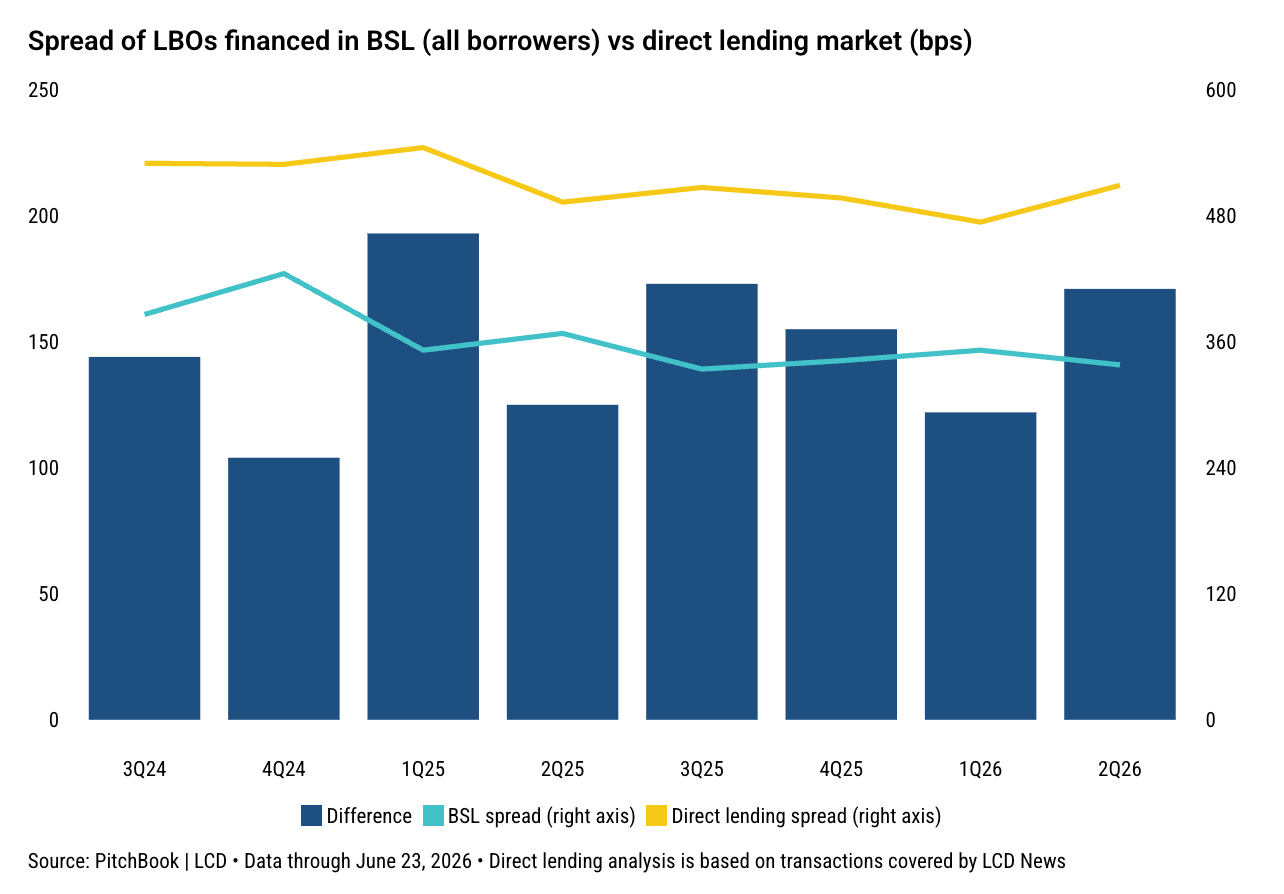
PitchBook LCD data show the spread between syndicated and private credit loans issued in the US hit 162 bps in the three months to August 31, about 39 bps wider than in Q1.
New-issue private credit spreads averaged 502 bps over the same period, up from 475 bps in Q1. On the syndicated side, VRC reports that the B-rated loan spread tightened from S+445 in June to S+412 in September. Private credit coupons stayed at SOFR plus 4.75% to 5.75%.
Where banks are winning
The clearest example is Catalent. In 2024, it borrowed a $4.2bn term loan from direct lenders to fund Novo Holdings' acquisition of Catalent. Last month it refinanced with a $4.1bn syndicated loan that it says will cut annual interest expense by about $100m. DC Advisory noted that no syndicated loans were refinanced into private credit in March, May or July.
PitchBook’s Q2 wrap found the BSL market has taken most LBO financing volume this year, a reversal from recent years, and LCD had not tracked a single direct-lending LBO financing above $2bn since early March, as of that report. Over the three months to July, direct lenders financed the fewest buyouts since Q3 2023.
Part of the cause is strain in the retail wrapper. The largest direct lenders, including Ares, Apollo and KKR, also run BDCs under redemption pressure, forcing those with significant retail exposure to rethink portfolio construction and position sizes.
Banks have also become secondary-market partners: As of mid-May, JPMorgan reported trading about $2bn of private credit loans across more than 20 borrowers, as managers listed more loans for sale than ever before.
The new model: banks originate, private funds hold
Banks aren't simply buying back shares. Many are partnering with the lenders they compete with, so that the bank keeps the client and the fee while the fund holds the loan. The pattern is repeating on both sides of the Atlantic.
JPMorgan. The bank has set aside $50bn of its own balance sheet, plus nearly $15bn from co-lenders, for direct lending. It lends directly to corporate and sponsor clients and brings in co-lenders for large deals. It has deployed over $10bn across 100+ transactions.
Bank of America. It has reportedly pledged $25bn of its own capital to private credit transactions.
Citi and Apollo. Their $25bn program, announced in 2024, lets Citi source and underwrite sponsor and corporate loans and allocate the exposure to Apollo-managed vehicles. It started in North America.
Wells Fargo and Centerbridge. Their venture, Overland Advantage, has deployed over $7bn in under two years. Centerbridge controls the BDC, with Wells Fargo as a minority investor and sourcing partner.
BNP Paribas and Apollo ATLAS. In 2024, BNP made a $5bn day-one commitment to finance investment-grade, asset-backed credit originated by Apollo and ATLAS.
BNP Paribas and Apollo in Europe. Bloomberg reported in February that the two were nearing a deal to jointly arrange loans for European corporate and PE-backed borrowers, copying the Citi model. The size has not been disclosed, and we could not find a final announcement.
For banks, the structure keeps client relationships and fees while keeping the debt off the balance sheet. Citi’s dealmakers and capital markets teams keep their client relationships and fees, and the debt stays off the bank’s balance sheet.
Apollo’s CEO has argued that when a bank can grow without using capital, it improves return on equity. For private lenders, the banks supply what they lack: origination reach, existing relationships, and structuring experience.
In Europe, BNP Paribas ranks first in European bond issuance and second in EMEA leveraged loans, according to Bloomberg data, and Apollo brings institutional demand for privately placed loans.
Banks also lend to the lenders
The quieter side of re-intermediation is that banks are both rivals and creditors of private lenders. They finance the funds through credit lines and back leverage, tying bank balance sheets to private credit performance even when banks make fewer direct loans.
How big is the link
JPMorgan holds about $50bn of loans to private credit funds, a product Bloomberg describes as debt layered on debt. FSB member data capture around $220bn in drawn and undrawn credit lines to private credit funds, and commercial data suggest the total could be higher. S&P cites an FSB estimate of $130bn in aggregate private credit exposures for euro area and UK banks.
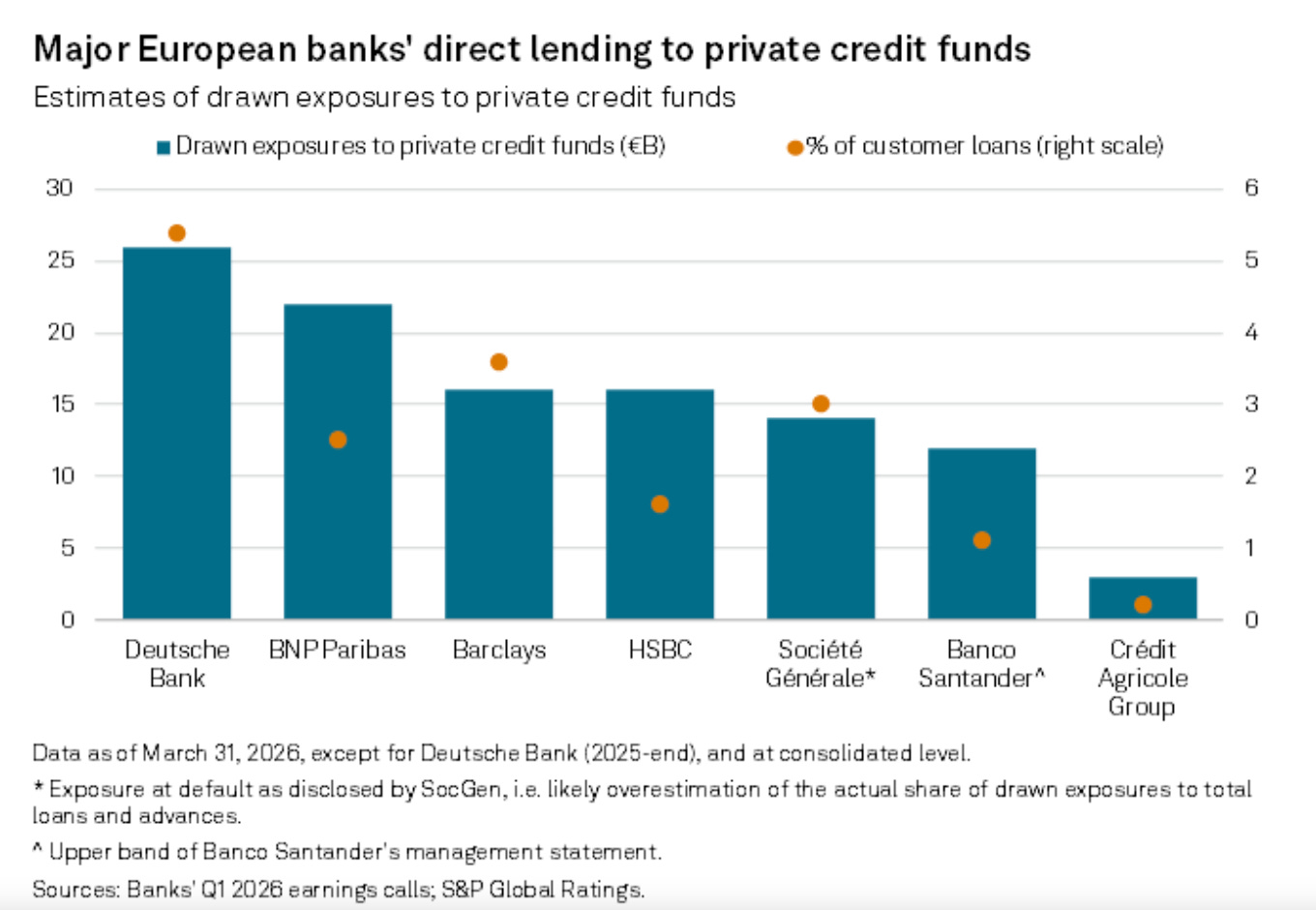
S&P Global Ratings sized the European picture in May. Seven large banks (Deutsche Bank, BNP Paribas, Barclays, HSBC, Societe Generale, Santander and Credit Agricole) have combined direct lending exposure to private credit funds of roughly €108bn, about 2% of their customer loans.
Deutsche Bank’s €25.9bn is 5% of its loan book. Italy’s two largest banks say their exposure is small: Intesa Sanpaolo’s CFO cited no material exposure, and UniCredit’s CEO called it very limited.
Why regulators watch it
The ECB notes that euro area banks are net debtors to the non-bank financial sector. Direct lending to private market funds is marginal, but the financing structures are opaque and often involve multiple layers of leverage, making the true risk hard to assess.
The European supervisory authorities flag wrong-way risk: bank funding to the sector rises just as private credit asset quality falls.
S&P adds that European banks’ concentrated lending to the software sector could gradually deteriorate fund portfolios, prompting banks to curtail fund financing and raise provisions.
Markets already price some of this. The ECB reports that bank share prices fell in early 2026 on concerns about private market exposure, and the Bank of England notes UK banks’ price-to-tangible-book ratios fell in March for similar reasons.
The ECB describes the general mechanism: shocks to non-banks can prompt banks to withdraw liquidity, and banks may then cut lending to non-banks, forcing them to deleverage. That is the feedback loop supervisors want to measure, and it is why they ask for better data.
Italy: banks are lending more, and private debt lends differently
Italy shows the re-intermediation question in a purer form. Banks are growing corporate lending at low rates, while private debt serves a narrower, PE-driven part of the market and relies on international managers. The two coexist more than they compete.
Banks are growing corporate lending
Bank of Italy data published on October 9 show loans to non-financial corporations up 4.2% year on year in August, from 4.1% in July. New loans to companies carried an average rate of 3.71%, 3.30% for loans above €1m and 4.40% for smaller ones. ABI says business lending rose for the 14th straight month. The Bank of Italy’s lending survey attributes higher Q2 demand mainly to inventories and working capital, and to debt restructuring and renegotiation.
Private debt is a different market
AIFI and CDP count €6.76bn of private debt invested in 2025, up 33%. The figure excludes banks, digital lending platforms and turnaround funds.
The pricing and profile differ from bank loans:
Price: the average spread was 5.38 points over Euribor. With three-month Euribor near 2.3% in June, that implies an all-in cost of roughly 7.7% (my arithmetic, indicative only), against 3.30% for bank loans above €1m.
Borrowers: 69% were PE-owned, 36% of the amount was for buyouts and 30% for growth. Leverage after financing was below 3.5x in 53% of deals.
Structure: 59% were loans and 25% bonds, 62% had bullet repayment, and a pledge over shares was the most common security (53%).
Size: deals above €100m reached €4.34bn, up 61%, while smaller deals were €2.42bn, up 2%. Excluding infrastructure, 52% of the financing went to companies with fewer than 250 employees.
Who lends: 52 active operators, with 86% of volume done by international ones.
That 7.7% versus 3.3% comparison mixes different risks, so it is not a like-for-like pricing gap. It does explain why banks and private lenders mostly serve different Italian borrowers.
Our own 0100 International release notes that nearly 30% of Italian PE financings in H1 2025 used private credit structures.
Let’s continue the conversation in Milan!
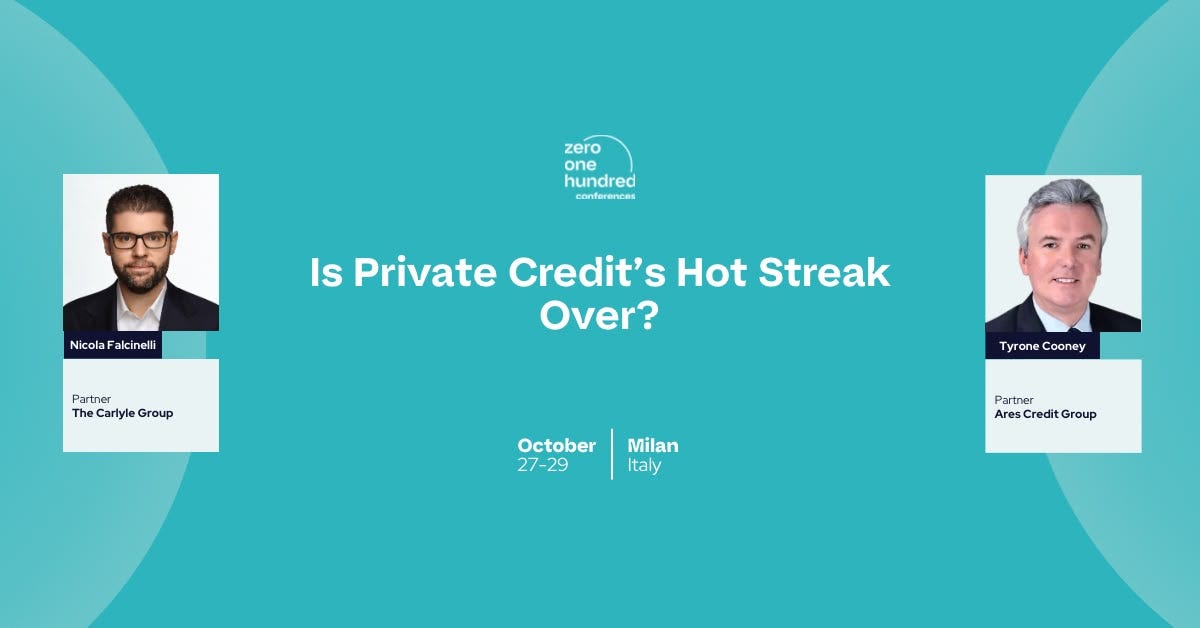
The bank-versus-lender question raises a bigger one: as the two camps converge, who ends up holding the risk, and who is left competing for the same borrowers? And where better to explore it than Milan?
We’ll host a fireside chat asking, “Is Private Credit’s Hot Streak Over?” and cover how lenders are adapting their strategies in a more uncertain environment, including risk dynamics, stressed and special situations, fundraising, and regulation. Bank competition and partnerships sit within that last point.