


Hello there,
What does it take to make a successful M&A deal in today’s market? For years, cheap financing, rising valuations, and easy exits made dealmaking more forgiving. But in 2026, the environment is different.
Borrowing costs are higher, lenders are more selective, and finding the right exit is no longer a sure thing. Buyers are examining value more closely, while sellers are becoming more flexible on deal terms.
This week’s brief looks at the new economics of M&A through data: how much is getting done and by whom, what financing now costs, how deal structures are changing, where exits are coming from, and which assets still command a premium.
And with 0100 International taking place in Milan this week, we're bringing these questions directly to the investors shaping the market.
M&A has become a barbell
Big deals are driving M&A growth in 2026, but the broader market is still struggling to regain momentum. Large companies and well-funded investors are making major acquisitions, while smaller buyers face higher financing costs, tougher valuations, and fewer exit opportunities.
According to PwC’s 2026 mid-year M&A outlook, global deal value was on track to reach $4 trillion in 2026, up around 13% year over year, potentially making it the strongest year since 2021.
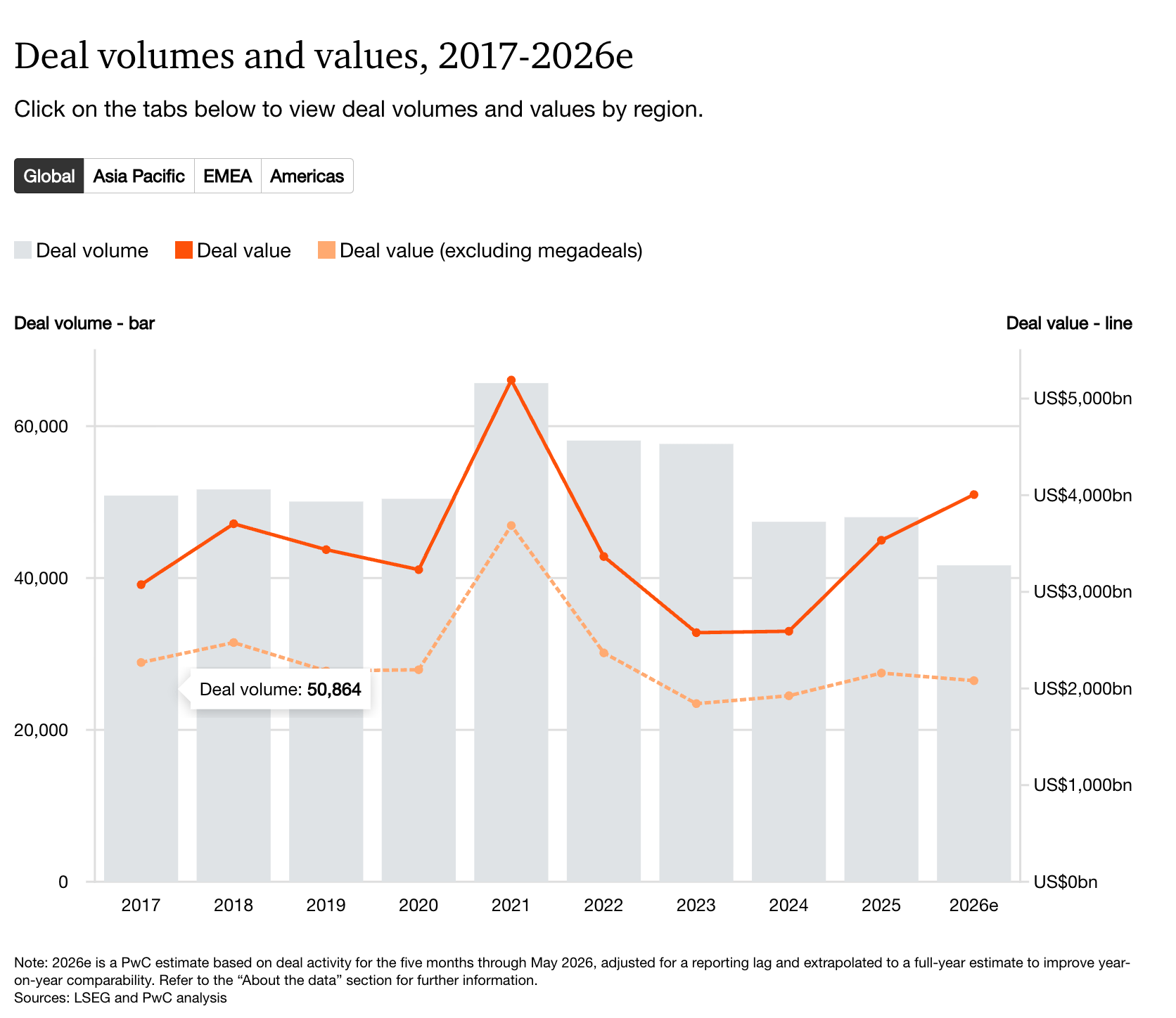
But the growth is far from evenly spread. Deals worth more than $5 billion accounted for nearly half of global M&A value in the first part of 2026, twice their share two years earlier. Excluding these megadeals, overall deal value fell 4%.
This points to a market increasingly dominated by large, well-capitalized buyers rather than a broad recovery in deal activity.
The US remains a major driver. According to PwC’s 2026 outlook, it accounted for more than half of global deal value in 2025, despite representing less than a quarter of transactions. This concentration has continued to shape the market in 2026, with technology, energy, and infrastructure attracting significant investment.
Financing costs are keeping buyers selective
Access to capital remains one of the biggest factors shaping M&A decisions.
PwC’s mid-year analysis highlights higher interest rates, inflation, valuation gaps, and economic uncertainty as key obstacles for mid-market transactions.
Financing is still available, particularly for large companies and established private equity firms. However, buyers are paying closer attention to debt costs, cash flow, and the returns they can realistically generate.
Private credit is also playing a bigger role, offering more flexible financing for complex acquisitions.
Private equity: Plenty of assets, but exits remain difficult
Private equity firms continue to pursue acquisitions, although activity is increasingly concentrated among larger sponsors.
According to PwC’s private equity outlook, global private equity deal value reached nearly $2 trillion in 2025, up from approximately $1.6 trillion in 2024. Yet the number of transactions fell from around 36,500 to 34,300.
The bigger challenge is selling existing investments.
PitchBook data cited by PwC shows private equity firms held 32,979 portfolio companies as of March 2026, up from 32,776 at the end of 2025. Around 34% had been held for more than five years, adding pressure on fund managers to find exits and return capital to investors.
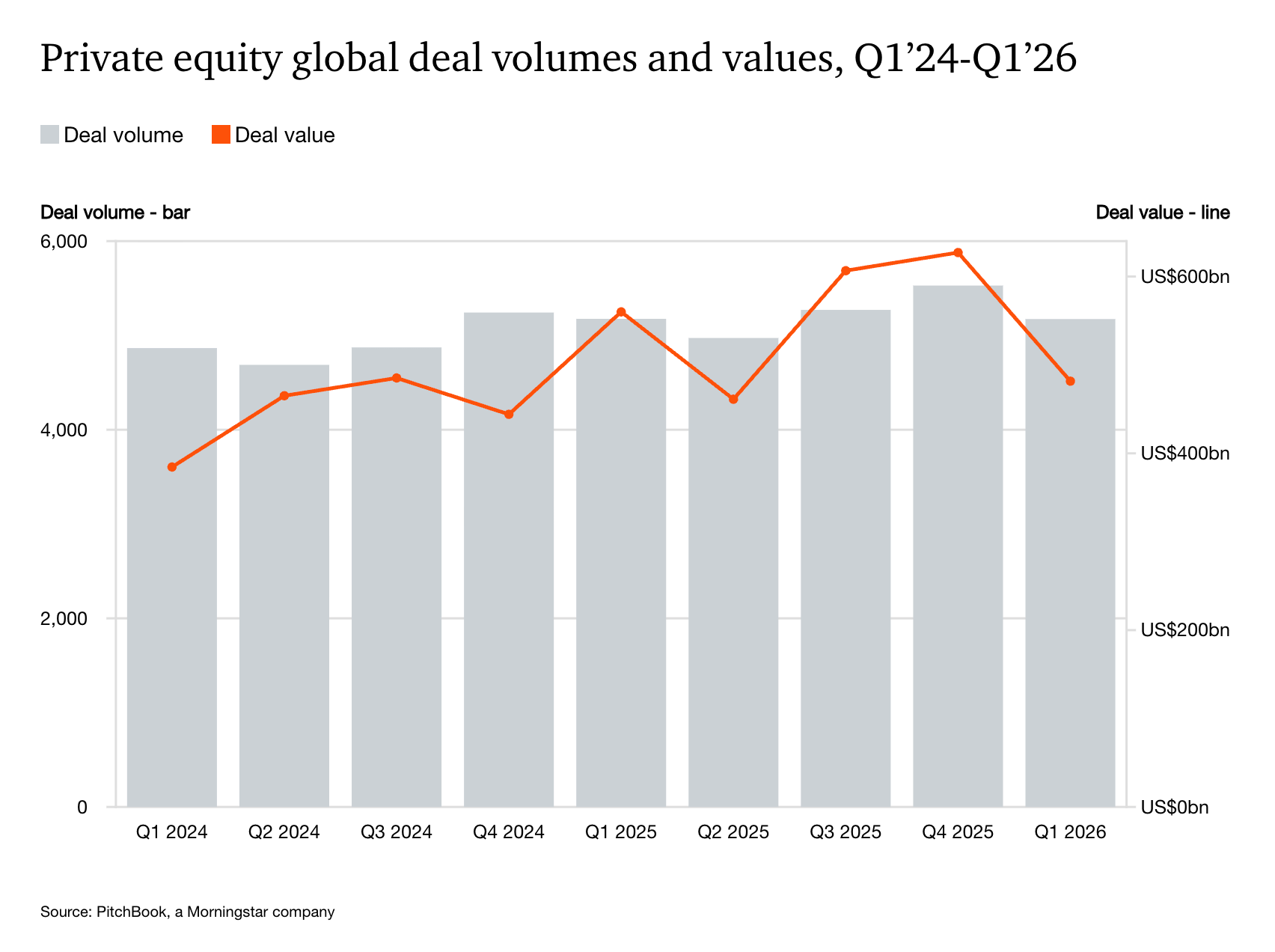
With traditional exits still difficult, firms are increasingly relying on secondary sales, continuation funds, and transactions between private equity sponsors to unlock liquidity.
Private equity buyers are putting more cash into deals
Higher borrowing costs are changing how private equity firms finance acquisitions. Sponsors are using less debt, contributing more equity, and paying closer attention to the returns their investments can generate.
According to Valuation Research Corporation’s Q3 2026 private credit report, unitranche loan yields reached 9.33%–10.08%, up from 8.98%–9.73% in the previous quarter.
Competition between banks and private lenders is also changing the market. Large, financially strong borrowers can often secure cheaper financing through syndicated loans, while private credit remains attractive for deals that need flexibility, speed, or more complex structures.
As an early PitchBook webinar notes, lenders are paying closer attention to credit quality, refinancing risks, and exposure to disrupted sectors.
Sponsors are relying more on equity
Higher borrowing costs are changing how private equity firms fund acquisitions.
Using less debt means sponsors need to contribute more capital to complete an acquisition.
Consider a €100 million buyout. In a higher-leverage deal, a sponsor might contribute €50 million in equity and borrow the remaining €50 million. In a more conservative structure, the same acquisition could require €65 million in equity and just €35 million in debt.
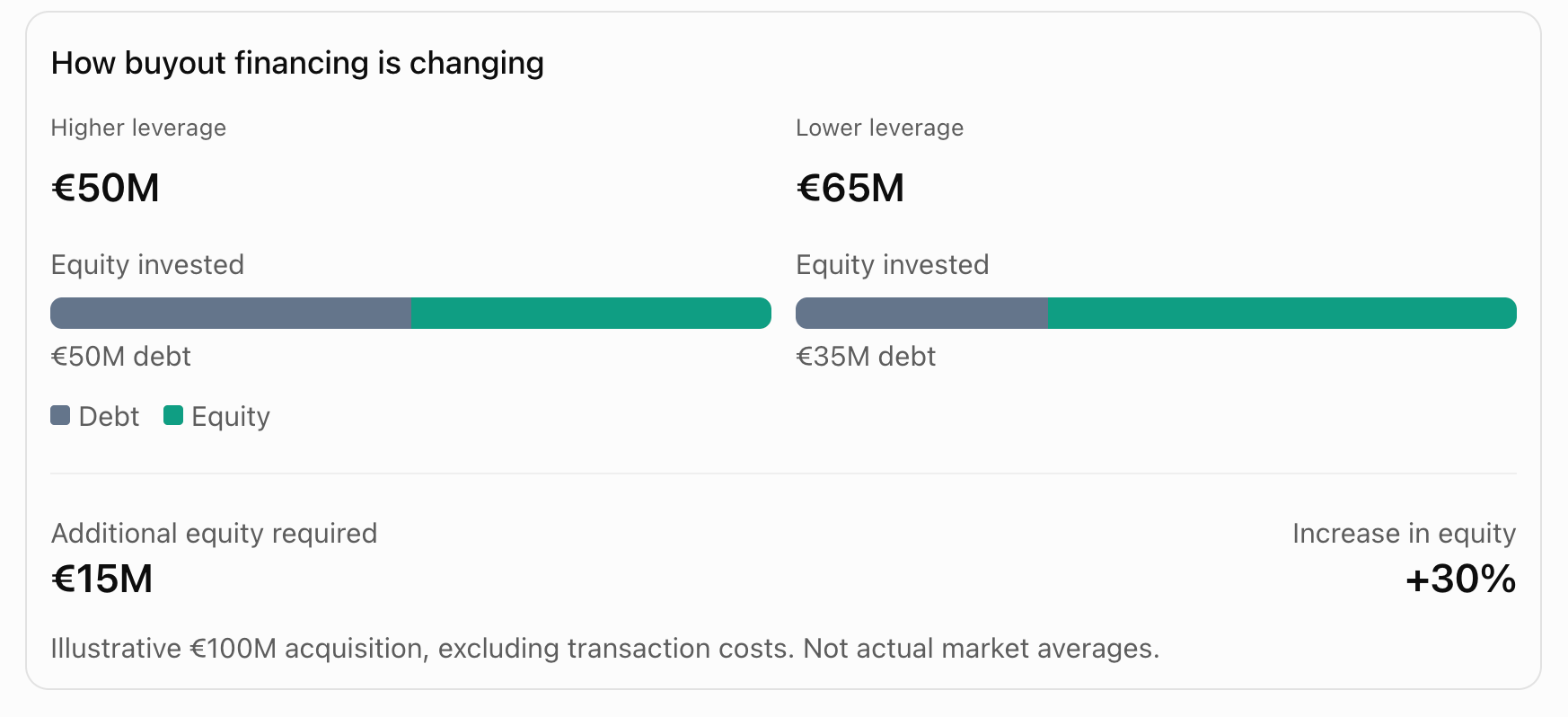
The second structure reduces debt obligations and financial risk, but it also ties up more capital in the deal. To achieve the same return on equity, the business may need to deliver stronger earnings growth or a higher exit value.
Older deals face the biggest pressure
Deals completed in 2021 and 2022 face particular pressure as loans arranged during the low-interest-rate period approach refinancing.
According to Valuation Research Corporation’s Q3 2026 analysis, these older deals generally carry more debt and have less room to absorb higher interest payments. Sponsors may need to refinance at higher rates, contribute additional equity, or renegotiate terms with lenders.
Newer deals typically have more conservative financing structures, making cash flow and the ability to cover interest payments increasingly important measures of financial strength.
Europe: Financing remains available, but lenders are selective
Europe is seeing similar trends.
According to Valuation Research Corporation’s Q2 2026 European market update, traditional mid-market unitranche loans carried interest margins of approximately 5%–6% above benchmark rates.
European direct lending activity fell about 35% in the first half of 2026, from €23.5 billion to €15.2 billion.
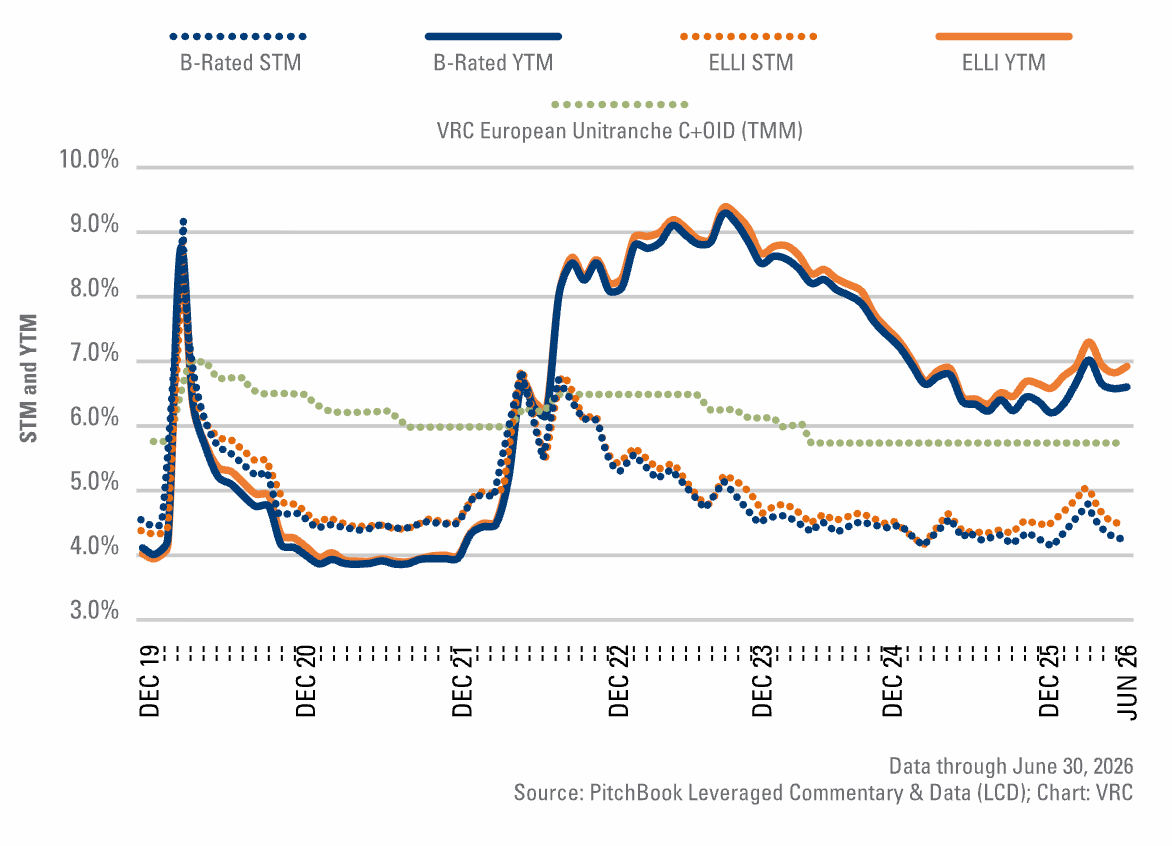
Despite the slowdown, private lenders still have significant capital available. Competition remains strong for high-quality companies, while riskier borrowers face higher costs and tougher lending conditions.
Italy: Fewer completed deals, but international interest remains strong
Italy’s M&A market slowed in the first half of 2026.
According to KPMG’s H1 2026 Italian M&A report, 637 deals were completed, down 14%, totaling more than €22 billion, compared with €30 billion in the same period of 2025.
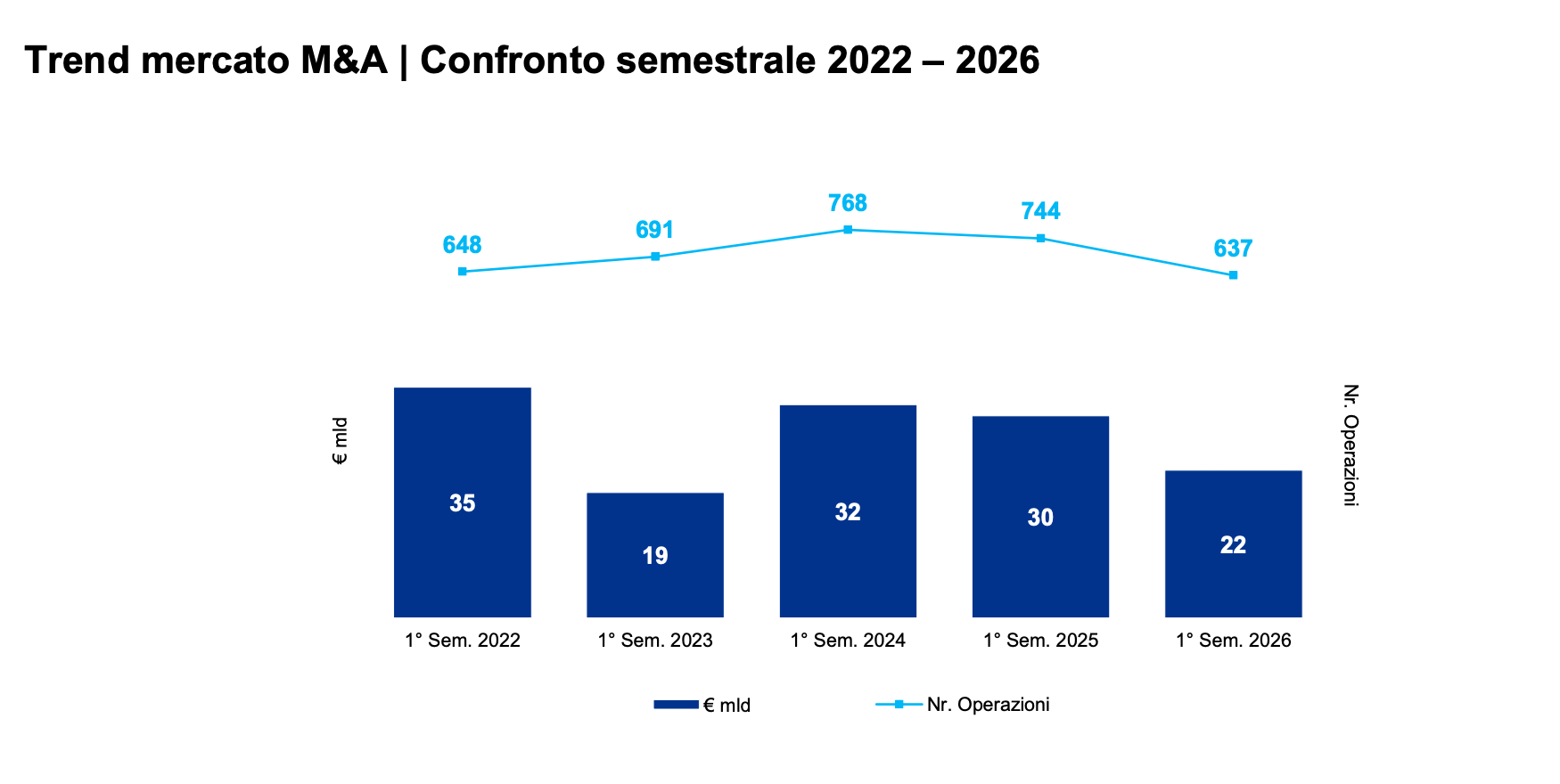
However, international buyers are still showing interest in Italian companies.
Foreign acquisitions of Italian businesses reached €8.2 billion across 195 deals, compared with €6.9 billion across 224 deals a year earlier. This suggests that although foreign buyers are completing fewer transactions, they are investing more capital per deal on average.
Three sectors accounted for around 69% of total Italian M&A value:
Technology, media, and telecommunications: €6.4 billion
Industrials: €4.6 billion
Energy and utilities: €4.4 billion
KPMG also identified a pipeline of more than €60 billion in announced but unfinished transactions at mid-year, offering potential for a stronger second half.
Italian private equity: Active, but increasingly cautious
Private equity remains an important source of investment in Italy, although fund managers are becoming more selective.
According to Deloitte’s Italy Private Equity Confidence Survey for H2 2026, investors expected 251 private equity transactions in the second half of 2026, down 28% compared with the previous year.
The outlook points to a more cautious market, where sponsors are placing greater importance on company performance, valuations, and their ability to create value after an acquisition.
For Italian mid-market businesses, private equity remains an important source of capital, especially for companies looking to expand internationally, acquire competitors, or prepare for a change in ownership.
Let’s continue the conversation in Milan!
We’re bringing this conversation to 0100 International this week at Palazzo Castiglioni in Milan! So, please join us for “The New Economics of M&A,” where leading voices from private equity, venture capital, and the wider investment community will discuss how dealmaking is evolving.
The panel will bring together Raffaele Legnani, Managing Director and Head of the Italian Office at H.I.G. Capital; Stefano Zavattaro, Partner and Head of Italy at CAPZA; Yuri Pizzasegola, Managing Director at Bridgepoint; and Paolo Magni, Partner at Alpha Private Equity. Francesco Calia, CEO and Co-Founder of Quido, will moderate the discussion.
Together, they’ll share their perspectives on how investors are adapting their acquisition strategies, what makes a deal attractive in today’s market, and where they see the strongest opportunities for value creation.