

Turning ESG Reporting into Value Creation: The Next Frontier for Private Equity – 0100 Weekly Brief


Hello there!
We’re entering a new phase in private equity. ESG reporting is no longer just a nice-to-have. Clear, consistent, and verified sustainability data now plays an important role in how capital is allocated and how fund performance is evaluated.
Private equity firms have already been experimenting with ESG disclosure for several years, but the difference now is that they (and their LPs) are starting to make sense of the data.
According to McKinsey’s Global Private Markets Report 2025, after two years of decline, private equity deal value rebounded by 14 % in 2024, reaching about $2 trillion. That recovery shows us how firms are doubling down on performance levers, not just financial engineering, but operational improvements, risk management, and selective capital deployment.
But this changes are not taking place without seeing major friction. Many firms still face challenges in:
Data fragmentation and comparability — ESG metrics are reported under different frameworks, with divergent assumptions and estimation approaches.
Assurance and verification gaps — third-party audit or assurance of ESG disclosures remains limited, especially for private portfolio companies.
Causal linkage to value levers — it remains difficult to trace how ESG improvements translate into revenue growth, margin expansion, or reduced capital cost.
Resource constraints & scale — building systems, processes, and expertise takes investment and discipline, especially in smaller firms or markets.
That’s why this week, we’re discussing ESG reporting in private equity — not just as a compliance box to check, but as a bridge to genuine value creation. We’ll explore how firms are evolving, identify the biggest gaps that remain, and discuss how to move beyond reporting toward measurable, strategic impact.
A clear example of this can be seen in our most recent interview, “Two-Track ESG: How Norvestor Turns Compliance into Value Creation.”, with Norvestor, which we invite you to discover below.
The ESG Reporting Moment
According to an EY-Parthenon analysis, funds that have deeply integrated ESG practices into their operations can achieve internal rates of return (IRR) up to eight percentage points higher than peers who treat it as a side function.
The change is happening because ESG factors are now influencing everything from how deals are sourced and evaluated to how value is created and realized at exit.

The real opportunity lies in integrating ESG into every stage of the investment lifecycle, not just the annual report. Embedding ESG principles into deal origination, due diligence, and post-acquisition plans enables firms to identify risks earlier, spot growth opportunities, and create stronger, more resilient companies.
Investors are also rewarding those efforts: companies with strong ESG credentials are increasingly seen as lower-risk and higher-potential assets, often commanding better valuations and smoother exits.
From Regulation to Opportunity
With new EU regulations, such as the CSRD, now taking shape, and limited partners (LPs) requesting more precise, more consistent data, ESG reporting has evolved far beyond simple compliance. It’s becoming a measure of how credible and future-ready a fund really is.
Investors are increasingly viewing strong ESG reporting as a sign of disciplined management, lower risk, and better long-term performance, turning transparency itself into a genuine competitive advantage.
The ESG Data Convergence Initiative (EDCI) is also one of the key efforts driving this forward; it aims to standardize ESG metrics across private equity, enabling LPs and GPs to benchmark and compare performance more meaningfully.
Under EDCI, submitted data is validated, run through consistency checks, and benchmarked against peers to flag anomalies.
But it’s no small task for mid-market GPs. Cost pressures, data gaps, and portfolio heterogeneity make it tough to collect, standardize, and assure ESG metrics. To bridge those gaps, many firms are now adopting digital ESG platforms and data management tools.
These systems automate data collection, perform validation checks, integrate with APIs, and provide dashboards to monitor progress. Alongside that, external validation, via auditors or assurance providers, is becoming more common, as it helps build credibility with LPs and reduces investor skepticism.
ESG as a Value Driver
Norvestor is one of the leading private equity firms in the Nordics, with over 30 years of experience in building regional champions across sectors. Rather than treating ESG as a reporting obligation, Norvestor uses it as a practical framework to strengthen operations, reduce costs, and future-proof portfolio companies.
According to their latest Sustainability Report, in 2024 alone, their portfolio reduced total carbon emissions by 18% compared to the previous year—a result of concrete actions, including improved data quality, targeted efficiency measures, and enhanced carbon management.

Norvestor’s approach is built on the idea that responsible business is smart business. Each portfolio company undergoes a double materiality assessment to identify sustainability topics that are both financially and socially significant. This process helps uncover risks early — from supply chain vulnerabilities to regulatory exposure — while also revealing growth opportunities such as circular models, energy efficiency, or digital innovation.
The firm’s use of third-party assurance under ISAE 3000 adds another layer of credibility, giving investors confidence that ESG data is accurate and decision-useful.
Two-Track ESG: How Norvestor Turns Compliance into Value Creation
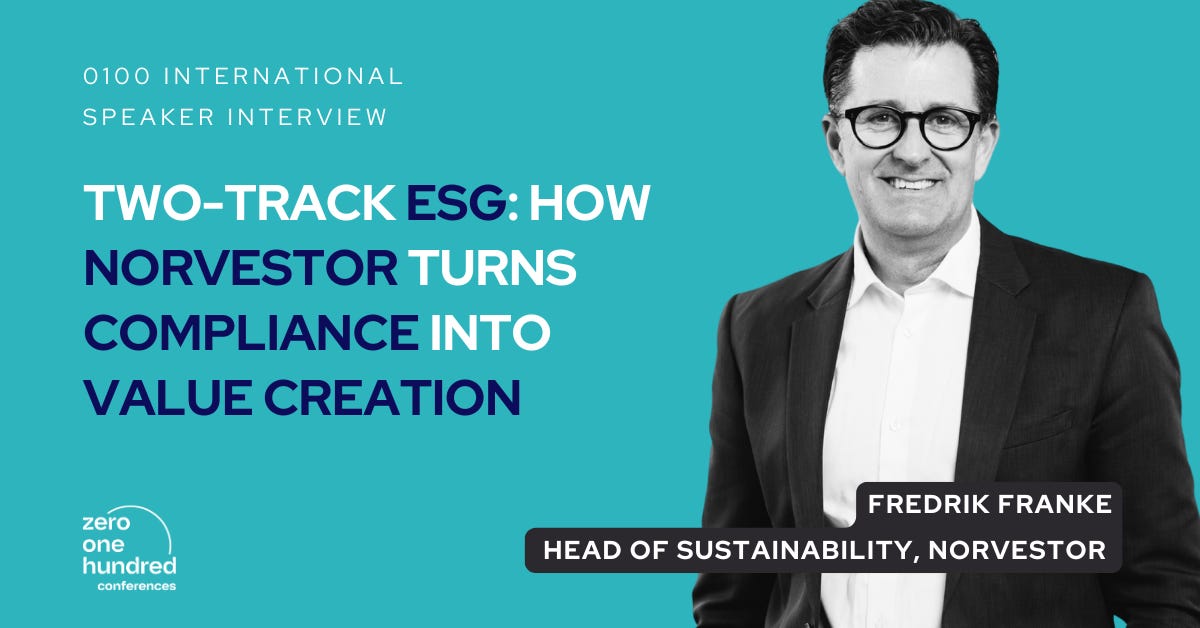
Norvestor’s Head of Sustainability Fredrik Franke, who joined in 2024 after 25+ years in sustainability and a stint at BCG, explains how the Nordic-rooted PE firm turns ESG into enterprise value.
With €6.3–6.4bn AUM, ~35 portfolio companies, and a track record of ~100 control investments, 60–65 exits, and 15–16 IPOs, Norvestor’s latest consolidated report shows real progress: credible Scope 1–3 data across SMEs and a year-on-year emissions decline despite acquisitions.
Franke details a two-track approach:
exit-readiness/compliance and
commercial levers like tire retreading (up to 4×, ~75% lower carbon).
He also outlines standardization on VSME Comprehensive (CSRD for bond issuers), double materiality for all, Article 8 funds, intense LP scrutiny (1,200+ DDQ questions), rapid take-up of SPV3 (~€3bn), and the firm’s expansion beyond the Nordics into Germany and the UK.
Deep Dive into ESG Reporting at 0100 International

In a world defined by geopolitical tension, supply chain instability, and diverging regulations, ESG has moved well beyond policy checklists. At 0100 International, we’ll look at how top firms are adapting — integrating ESG into investment decisions, enhancing value creation, and staying aligned with evolving LP expectations.
The discussion brings together two seasoned sustainability leaders: April Tissier, Sustainability Director at Ardian, and Noëlla de Bermingham, Chief Sustainability Officer at Andera Partners. Both bring deep experience in embedding ESG at the heart of private equity strategy. From reporting and regulatory frameworks to portfolio transformation and investor engagement, they’ll share how their firms are navigating this complex landscape.
🌍 Across the Ecosystem | News & Useful Resources for You
We’re not the only ones rethinking what ESG reporting really means in private equity today. With new regulations coming into force, LPs demanding clearer disclosures, and managers under pressure to prove measurable impact, the conversation around transparency, accountability, and long-term value creation is gaining real momentum across Europe and beyond.
Here’s a spotlight on the perspectives shaping how private equity firms are redefining ESG reporting — turning it from a compliance task into a core part of how they build trust and deliver performance.
📄 Article | How ESG due diligence is influencing private equity deal-making
Today, funds that incorporate ESG principles into their investment processes are outperforming their peers in both financial and operational terms. According to a 2024 ESG report, 73% of private equity investors have already implemented robust ESG frameworks, and funds with strong sustainability practices are seeing higher valuations at exit — especially those qualifying under Article 8 and 9 of the SFDR.
Many firms are also leveraging climate risk assessments and digital tools to enhance transparency, streamline reporting, and meet growing LP expectations.
🗞️ News | World’s biggest pension fund puts impact investing on the agenda
Japan’s $1.8 trillion Government Pension Investment Fund (GPIF) is setting a new precedent by putting impact investing on its agenda.
The fund’s exploration of impact strategies has already prompted several other major Japanese pension funds to update their own policies, signaling a broader change across the country’s $5 trillion asset management industry. The government is backing this approach as part of a national strategy to address social challenges, including climate change, healthcare, and inclusivity in an aging population.
📄 Article | How investors are adapting ESG policies on defence
European investors are reassessing their ESG policies in response to shifting global priorities driven by geopolitical tensions and security risks. Once excluded from most sustainable investment strategies, the defense sector is now being reconsidered under a new lens, one that balances ethical concerns with the need for national and regional security.
Major LPs and GPs across Europe, including those in Finland and Denmark, are updating their ESG frameworks to allow for selective exposure to defense-related assets, provided these assets align with responsible investment principles.