


Hello there,
This week, we’re looking at a deal that may reshape how private capital flows into the AI buildout: Nvidia’s $500bn financing partnership with six of Wall Street’s largest asset managers.
Few companies have shaped the AI infrastructure story quite like Nvidia. Long before this week’s announcement, the chipmaker had already become the connective tissue of the AI economy, supplying the GPUs that underpin nearly every leading model, while increasingly financing the customers who buy them.
Last week, that role expanded further. Nvidia signed memorandums of understanding with Apollo, Blackstone, BlackRock, Brookfield, Goldman Sachs and KKR to mobilize more than $500bn in third-party capital for AI infrastructure, one of the largest coordinated financing efforts Wall Street has assembled for a single sector.
Nvidia - From Chipmaker to Capital Allocator
For most of the AI boom, capital flowed in a familiar pattern: hyperscalers and labs raised equity and debt on their own, then used the proceeds to buy chips from Nvidia. Nvidia sold hardware; financing was someone else’s problem.
Under the new arrangement, six of the world’s largest alternative and traditional asset managers will build dedicated financing platforms designed to lend to Nvidia’s customers “at attractive rates,” according to Nvidia’s announcement.
Jensen Huang has described the ambition as turning compute into a new class of productive, investable infrastructure. Language that treats AI data centers much like toll roads or power plants: bankable assets you can borrow against.
In other words, Nvidia is no longer just supplying the shovels. It is helping arrange the mortgage. For private equity investors, this formalizes and scales up something firms like Apollo and Blackstone were already doing piecemeal: structuring infrastructure-style debt for AI-heavy balance sheets at companies including Meta, Intel and Anthropic.
The $500bn Deal's Built-In Conflict of Interest
The market’s initial reaction was not entirely positive. Nvidia shares fell roughly 3% on the day the news broke, and the arrangement has revived a long-running concern: if Nvidia helps finance the purchase of its own chips, how much of the AI infrastructure boom is being underwritten by Nvidia’s own balance sheet, directly or indirectly?
Huang has said Nvidia may still back up to 25% of a given financing opportunity, a detail that keeps the circularity question alive even as the bulk of the capital is meant to come from outside investors. Ratings agencies have also flagged that aggressive AI capex is already squeezing free cash flow at hyperscalers such as Amazon and Alphabet — a dynamic this financing push is partly designed to relieve by moving debt off customers’ balance sheets and onto dedicated third-party vehicles instead.
For PE and private credit allocators, the read-through is a familiar one: attractive yield, real underlying demand, but concentration risk in a sector where the largest buyer, largest supplier, and largest financier increasingly overlap.
Spending Faster Than They're Earning
The backdrop makes the urgency clear. Moody’s projects hyperscaler AI capex will hit $785bn in 2026 and roughly $1tn in 2027, about six times 2022 levels.
Epoch AI’s analysis of SEC filings found capex growing almost 70% a year, while cash flow grew just 23%, with free cash flow across the largest cloud providers expected to hit zero around the third quarter of 2026.
The off-balance-sheet piece is arguably the more important number for private credit investors: Moody’s estimates hyperscalers are carrying roughly $662bn in signed-but-not-yet-commenced data center lease commitments, a figure larger than the group’s combined on-balance-sheet debt. This is precisely the gap platforms like Nvidia’s are built to fill, moving financing off customers’ books and into dedicated third-party vehicles instead.
The credit-market response has already started. S&P downgraded Oracle from BBB to BBB- in July, one notch above speculative grade, largely over its buildout obligations to OpenAI. Alphabet’s free cash flow turned negative for the first time since its 2004 IPO after a $44.9bn quarterly capex figure, prompting an $85bn equity raise — the largest in corporate history.
Nvidia’s own deal isn’t the first of its kind, either. CoreWeave’s $21bn financing arrangement with Meta and Anthropic, and Nvidia’s own $40bn in AI equity commitments in the first five months of 2026, show this is a pattern accelerating well before last week’s announcement.
How Big Is Big? Sizing Up the Consortium
The six-firm coalition brings enormous dry powder to the table.
Apollo manages roughly $1.05tn in assets;
Blackstone oversees more than $1.3tn across real estate, credit and infrastructure;
Brookfield manages over $1tn with deep exposure to physical infrastructure and energy.
BlackRock’s Larry Fink has compared the initiative to the birth of mortgage-backed securities in the 1970s
Morgan Stanley projects hyperscalers will spend roughly $3.5tn on AI infrastructure between 2026 and 2028. Apollo’s Jim Zelter has put the total AI infrastructure capital need north of $8tn, a figure that makes even a $500bn financing platform look like a down payment rather than a solution.
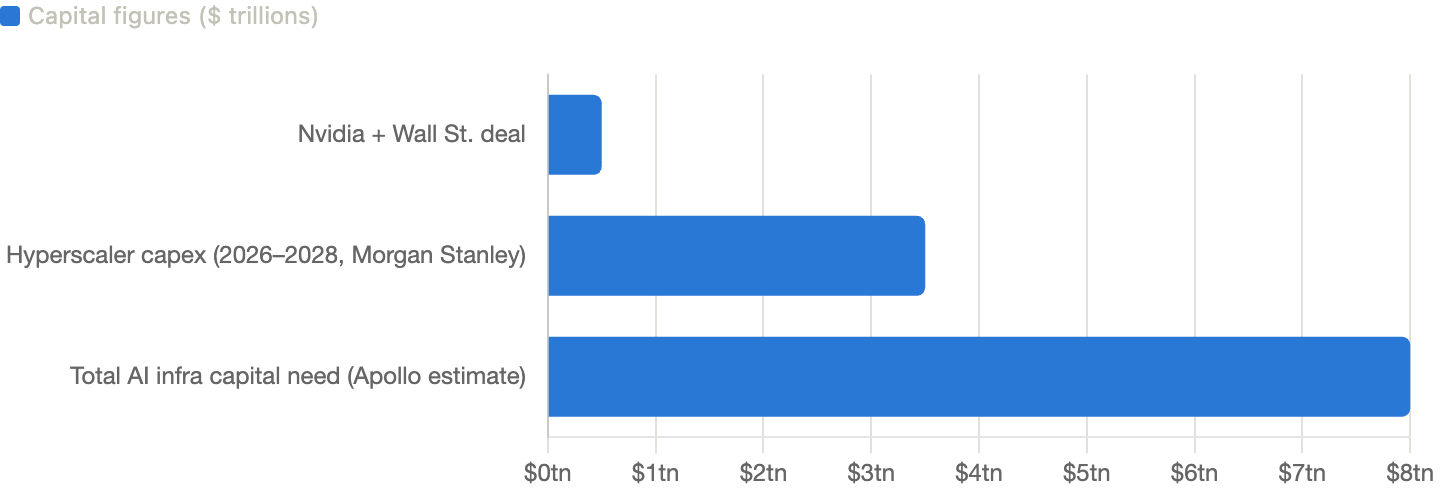
Set against the broader private markets backdrop, this deal is another data point in a trend we've been tracking: the largest, most consequential value creation in this cycle, whether it's SpaceX's pre-IPO climb or the AI infrastructure buildout, is happening inside private capital structures, not public markets.
The Bigger Pattern: Private Capital Eating Public Risk
Set against the broader private markets backdrop, the Nvidia deal is one data point in a much bigger market change.
Morgan Stanley estimates a $1.5tn gap between what hyperscalers’ own operating cash flow can cover and what global AI data center investment will require through 2028, and projects that private credit alone will supply roughly $800bn of that bridge, well ahead of corporate bonds or securitized products.
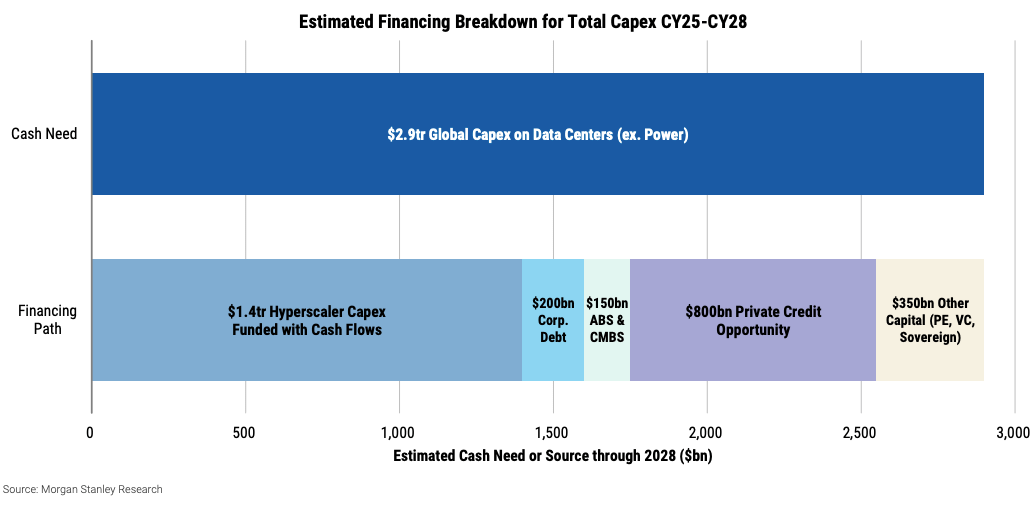
That’s not a niche corner of the market anymore. Goldman Sachs Research expects infrastructure funds, which raised a record $221bn last year, to roughly double from $1.7tn to $3tn in assets by 2030, as hyperscalers plan more than $5.3tn in combined capex between 2025 and 2030.
The private credit market as a whole is already sitting at roughly $1.5tn to $2tn, according to the Financial Stability Board, and AI infrastructure is quickly becoming one of its fastest-growing sub-sectors.
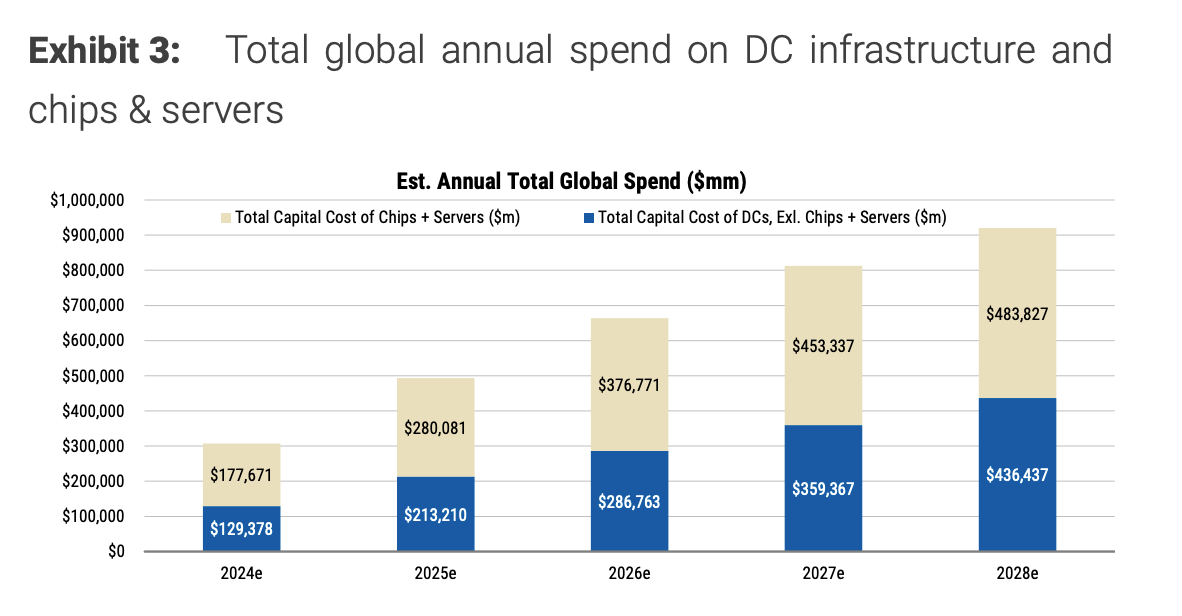
The mechanics matter here as much as the size. Because BlackRock and Goldman Sachs both manage significant pension and retirement assets, deals like this mean 401(k)s and index-linked portfolios could end up with indirect exposure to AI infrastructure debt, without most investors ever choosing that exposure directly.
Nvidia’s move to formalize compute financing through Apollo, Blackstone, BlackRock, Brookfield, Goldman Sachs and KKR is a further sign that the boundary between “chip supplier,” “asset owner” and “lender” is dissolving, with private capital sitting at the centre of all three roles, and increasingly, at the centre of who actually bears the risk if the AI capex cycle disappoints.
Let’s Continue the Conversation at 0100 Emerging Europe!

As global capital pours into infrastructure and AI at the scale we've already seen above, that same wave of capital is reshaping how deals get done closer to home.
At 0100 Emerging Europe in Budapest next month, one of our panels tackles this head-on: how regional private equity firms compete for assets as international investors and growing pools of global capital move deeper into Emerging Europe, and how that competition is shaping valuations, deal structures, and investment strategy across the region.
Joining the discussion are three of CEE's most established dealmakers. Aleksander Kacprzyk, co-founder and Managing Partner at Resource Partners. Marek Rodak, Partner at MidEuropa, and Edgar Kolesnik, Partner at Abris since 2014, focus on digital, business services, industrial, and consumer deals, with additional oversight of talent management and ESG across the portfolio.